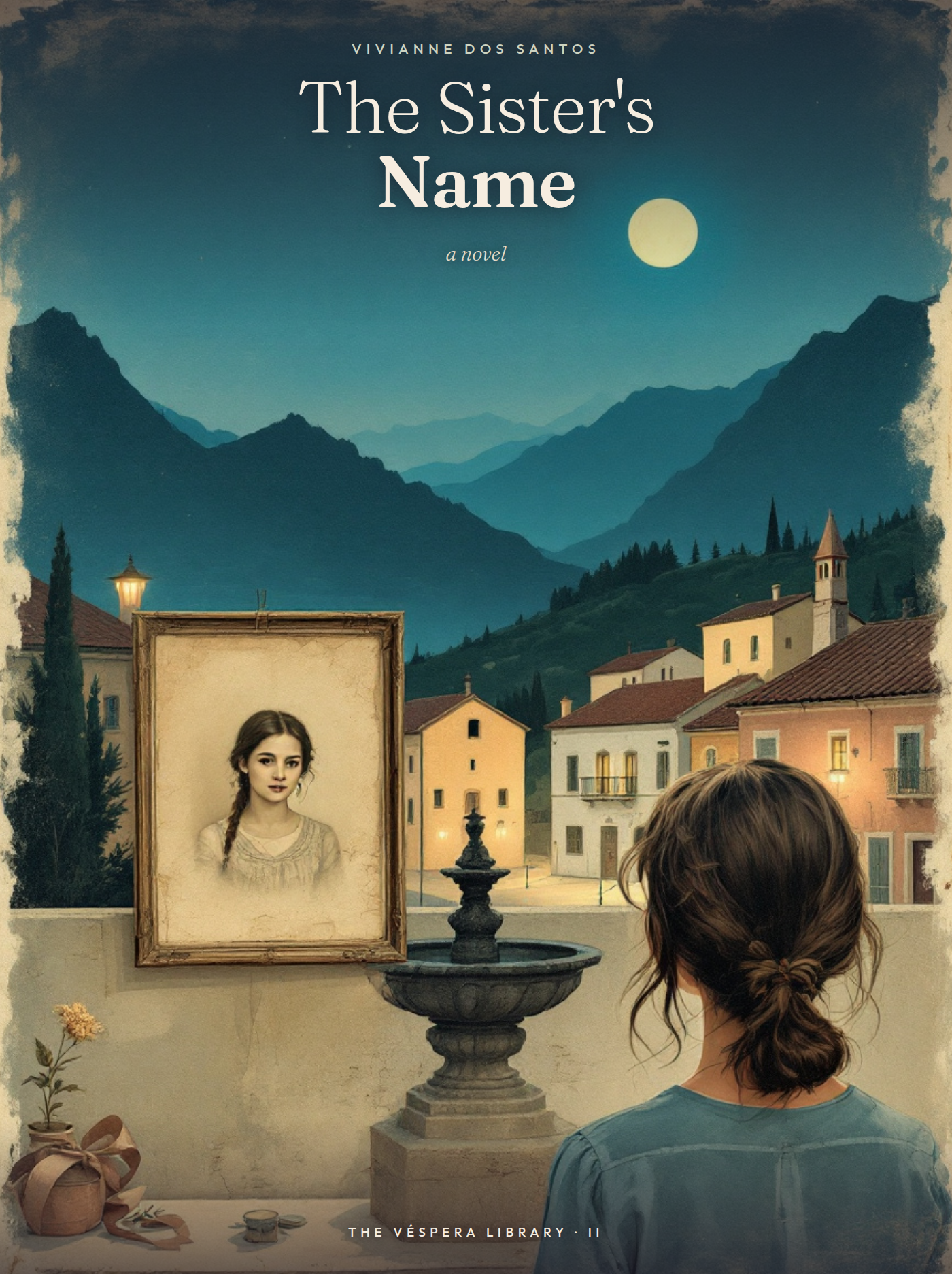
The Sister’s Name
Eufémia was given her dead sister's name, and with it her sister's life: the course, the promised fiancé, the house on the square. At fifty, emptying her mother's room, she finds the certificate, and realises she never chose anything.
A novel · 12 chapters, complete. Read the first one below; the whole book is in the shop.
From the register of Véspera
In the record of the village, in the hand of the Keepers who have kept the book, the same name is found entered twice, in the same writing.
Eufémia, daughter of Bendito and of Saudade. Born in the spring, dead in the spring, nineteen years between the one and the other. She was about to take her course in the City when the fever carried her off in nine days.
Eufémia, daughter of Bendito and of Saudade. Born in the winter when the river took the Bridge, nine months after the first was laid in the earth. The name was a promise: at the graveside, the mother put her hand on her belly and swore that the name would not die there.
The register says who was born and who died. It does not say who was left with whose life. For that, books such as this one are needed.
chapter one
The mother's room
In Eufémia's house, the day knew the way without asking her anything.
She woke at six, before the bell and before Leal, and the house received her already arranged: the previous day's bread in the bread's place, the supper dishes dried and put away the night before, the apron on the door's nail, hung by the left strap, because the right one chafed. There was nothing to decide. There were things to do, which is different, and Eufémia did them well and in the right order, with the quiet satisfaction of one who walks a beaten path and always finds it clean. If anyone had asked her whether she was happy, she would have answered yes without taking any time. That was the proof, she said to herself on the rare occasions when the question arose: true happiness does not need to think about the answer.
From the kitchen window the whole square could be seen, and in the middle of the square the fountain. The fountain of Véspera had been dry since before her birth: the water, which rises in the serra, was fetched from outside, and the fountain had stayed in the square the way certain pieces of furniture stay in houses, because no one had the heart to take from there a thing with that look of eternity about it. Eufémia liked it so. A fountain with water is a fountain that wears out; a dry fountain is always composed.
Leal came down at seven, his shirt buttoned to the top, as every day for twenty-five years.
"It is cold enough," he said, which was his way of saying that the summer had ended.
"I will take the shawl."
He nodded, satisfied, and sat in his place. Eufémia set before him the bowl, the bread, the honey, and sat in her place. They had the conversation of that hour: the roof of the old house, which would need seeing to before the rains; the vegetable garden; the mother. The sentences went and came already answered, like letters one writes knowing the reply by heart, and in that too there was comfort. Married like that, the village said, that was to see people who understood each other: never a raised word, never a slammed door. Leal was seventy-two and had the most careful hands in Véspera, and in twenty-five years of marriage he had never once forgotten her shawl when the weather turned.
"This afternoon I will go and fetch her," he said, setting down the bowl. "You finish at the school and walk on over there, to choose what comes."
"What comes is little," said Eufémia. "She wants almost nothing now."
"Even so. It is better that it be you to choose the little."
The school was on the other side of the square, and Eufémia crossed it at eight, in her shawl, at her steady pace. At the door of the House of the Register, the Keeper lifted the latch with the big key, slowly, and gave her the nod of the head she gave to the whole village at the same hour. Eufémia returned it, as always, without slowing. There were those who feared that house, the papers that slept there; she did not. Her papers were all in order.
At the door of the Shop, Benvinda was putting the fruit crates out, and straightened up when she saw her pass.
"It is today that your mother goes to your house."
It was not a question. In Véspera the news was not given: it was confirmed. Eufémia stopped just enough not to be rude.
"It is today."
"You do well." Benvinda wiped her hands on her apron, her head already inside the reckonings of another thing. "The old house stays shut?"
"It stays shut until we see."
"Until we see," repeated Benvinda, who knew as well as anyone what until we see means when one speaks of mothers' houses. "Tell her that this year's rosemary is good. She was always more for rosemary than for flowers."
Eufémia went on, and was already halfway across the square when she realised that the whole village knew the day, the hour and the rosemary, without her having said anything to anyone. She was not bothered. That was how things were, and there was rest in it: in a land where everything is known, there is nothing to tell.
She had the little ones, the first letters. She had been their teacher since before many of their parents knew how to read, and in that office, as in everything, she was sure: the village entrusted her with its children the way one entrusts the good linen to one who irons well. That morning they were on the lined notebook, on the letter e, which is one of the treacherous ones, and Eufémia went from desk to desk setting the world straight.
The littlest of the Serranos, who was left-handed and stubborn, had invented a way of her own of making the letter: she began it backwards, from the inside out, and the letter came out alive and crooked like a vine shoot.
"Look how the teacher does it," said Eufémia, and made, in the margin of the notebook, a perfect e.
Eufémia's writing was famous in Véspera. Round, even, sure as the hours: the council minutes were copied out by her, the signs for the festivals were hers, and when someone needed to write a letter that would be taken seriously, they came knocking at her door. They said it was a gift. She knew it was no gift at all: it was practice, an old notebook copied line by line through years of childhood, until her hand learned to walk by the way of another hand. But that she did not say, because it was not to the point, and because it was a long time since she had thought of it.
The little one looked at the perfect e in the margin, looked at her crooked e, and nodded, without any conviction. Eufémia straightened her letter without thinking more of the matter, the way one straightens a picture in passing, and went on to the next desk.
The mother arrived at the beginning of the afternoon, in the back seat, small as a well-made parcel.
Her name was Saudade and she was eighty-nine years old, and until the spring she had lived alone in the old house, in the street behind the churchyard, with a stubbornness the village admired aloud and lamented in a low voice. But in the summer she had begun to lose her days. She lost them the way one loses needles: she knew she had had them in her hand just now, and then nothing, and it was useless to look. She lit the fire and forgot it lit. She set the table for people who no longer ate there. In the last week, the neighbour had found her in the yard in her nightdress, at midday, waiting for no one knew what.
It was decided as it is always decided, and as it was always decided: without anyone deciding anything. The mother came to the daughter's house. It was the natural order of things, and Eufémia received it as she received the natural order of things, with the back room ready, the linen sheets, a jug of rosemary.
"This is for a while," said Saudade, at the door, without looking at anyone. "Until I am right again."
"That it is, mother. For a while."
The old woman went in slowly, stopped in the middle of the kitchen and looked around with a strange attention, of one who checks. Then she went to the window, saw the square, the fountain, and something in her settled.
"I always liked this house better than mine," she said, and went to sit down.
Eufémia took her to the back room after the afternoon snack, when the old woman began to fold over with sleep in the chair. Saudade went in, ran her eyes over the walls, felt the bedspread with the backs of her fingers, and lingered over the jug of rosemary more than over all the rest.
"Who taught you to make a bed like this was I," she said.
"It was, mother."
"Linen sheet is for feeling." She pulled the fold with two fingers, by way of proof. "It is well made."
It was the nearest to a thank-you that Saudade came to, and Eufémia received it as such. She helped her lie down, put the water within her reach, left the door ajar at the right angle, neither open nor shut, which was how the mother had always slept. She stayed a moment in the corridor, listening. Inside, the old woman said something, low, in the voice of one who is conversing. Eufémia waited for her to call. She did not call: the conversation was not with her, nor with anyone in the house, it was one of those the old have with their lost days, looking for the needles. She went off down the corridor with the light step one uses in the rooms of the sick and of children, and gave no importance to it, because it was a long time since she had decided to give none.
Eufémia went to the old house at the fall of the afternoon, alone, with the big key in the pocket of her coat, leaving the mother asleep and Leal with an ear on the house.
The house smelled of what the houses smell of where someone has lived a long time slowly: of stored apple, of cold ash, of clean clothes grown old in the drawers. Eufémia opened the windows out of system, more out of respect than out of necessity, and went straight to the mother's room, because she had not come to be moved, she had come to choose the little.
The room was the same as always. The high bed, the bedspread of squares, the father's portrait on the chest of drawers: Bendito, dead so long ago that he was now more portrait than father. Eufémia worked with method. Clothes to give away, clothes to take, papers for Leal to see, the rest to be decided later. She filled two sacks and a small chest and was not moved, which she noted with a certain pride, like one who verifies that the seam held.
She went to the bottom of the big dowry chest, beneath the linen shirts the mother kept for her death, with the ease of an only daughter.
Only daughter. That was how she thought of herself, out of habit, though she knew it was not exactly true. All her life she had known, in the way one knows as a child the things one does not ask: by half-words caught, by silences with a shape to them, by the way the old women of the square put their hand on her head and said "the very image" without saying the very image of what. There had been another before her. A sister who had died young, before she was born, and of whom in this house no one ever spoke: not ill, nor well, nor anything, which is the deepest way of speaking of someone every day.
Beneath the shirts, her hands met an edge of metal.
It was a tin box, of the biscuit kind, the paint worn to grey. It weighed little. Eufémia sat with it on the edge of the high bed, and stayed a moment still, with the box closed in her lap, listening to the house. Then she told herself that it was late, that there were still the sacks to carry, and opened it, because to open boxes was the work of that day.
Inside was a small portrait, a girl of eighteen or nineteen, serious for the camera as one was then, with a thick plait pulled to the front of the shoulder. Eufémia knew her without ever having seen her. She was like her as a word is like its echo: the mouth was her mouth, the brow was her brow, and the whole, one knew not why, was another person. She stayed looking at the girl longer than she wanted. It was the first time in her life that she saw her face.
Beneath the portrait was a notebook. Brown cover, worn corners, and on the cover, in ink gone rust, in a round writing, even, sure as the hours: *Notebook of preparation. Eufémia.*
The writing was hers.
That was what her body told her first, before her head corrected it: that that writing was hers. She knew that notebook. Not that copy, but its way: it had been by a notebook like that that the mother had set her to practise her writing, years of childhood, line by line, copy until it is the same. They had never told her the same as what. The same as the writing of the notebook, the mother said, and the writing of the notebook was beautiful, and the girl copied it until her hand learned to walk by that way, and the whole village came to say that Eufémia had a gift.
She opened the notebook. Notes of one preparing for an exam: rules, lists, sums done with application. The first page had a heading underlined twice: *To take to the City.* And beneath it, a list of small things, stockings, books, the alarm clock, written with the joy with which one writes the lists of the lives that are about to begin.
Eufémia closed the notebook with care, as though it slept.
Beneath the notebook there were still two things. A letter, sealed, with the paper yellow with time, and on the front, in a man's writing, new and laboured: *For Eufémia, by hand.* Eufémia did not know the writing, and then she knew it, and her hand set the letter down on the bedspread faster than it should have, like one who sets down a hot thing. She did not open it. She told herself that she did not open it because it was late, and knew perfectly well, in saying it, that it was a lie of the first water.
The last thing was a paper folded in four, of a more serious paper, with a white seal. That one she opened. It was a copy, made by the hand of an old Keeper, of the certificate of death.
*Eufémia, daughter of Bendito and of Saudade*, she read. The words were the usual ones of the registers, dry, sure, and said little: the spring in which she had been born, the spring in which she had died, the fever, the nine days. Nineteen years between the one and the other. And at the end, the old Keeper's hand closed the entry with the usual formula, the one that is read on all the papers of that house, *and of all of it a record was made.*
Eufémia stayed very still on the edge of the high bed, with the paper in her hands, and the house around her made the silence that houses make when at last one says what they knew.
It was nothing she did not know. It was all known matter, said in half-words for fifty years. There had been another. She had died young. She had her name; or she, she corrected herself, had the other's name. It was nothing new, and Eufémia repeated it to herself a few times, sitting on the edge of the bed, while outside it finished growing dark and she did not light the lamp.
But papers have this: they make tellable what went about loose. And in the dark of the mother's room, without meaning to, Eufémia's head began to do the sums. The sister had died in the spring. She had been born the following winter, in the winter when the river took the Bridge, all her life they had told her, you were born on the night of the great waters. From spring to winter. She counted on her fingers, slowly, pressing her thumb to each finger as she taught the little ones at school, and the fingers came out exact.
The mother was carrying her when she buried the first.
She had been at the burial with her in her belly, seven months or near it, doing the sums on her fingers. In mourning for one daughter and in hope of another, at the same time, in the same body. And at the edge of that grave a name had been decided, and the name had come straight to her, before she was born, before she breathed, the name was already there waiting, already had a notebook, already had a practised hand, already had a betrothed with a letter written and a house thought out, and Eufémia, fifty years later, sitting in the dark on her mother's bed, understood all at once, not as an idea but as a weight, in the way one understands a sack set on one's back, that never in her life had she chosen anything.
She got up, because the body wanted to do something. She tidied the box: the portrait, the notebook, the unopened letter, the certificate folded in four. She closed the tin lid, which gave with the tired click of old metal, and stood in the middle of the room, with the box in her hands, in the dark.
"Eufémia," she said, aloud.
She did not quite know which of the two she was calling. The house, for its part, did not answer either: it stayed silent around the name, as the whole village had stayed silent around it for fifty years, waiting to see who would come to lift it.
She took the box with her, under her arm, inside her shawl. The square was deserted at that hour, and the dry fountain was a composed shape against the first lights. Eufémia crossed it at her steady pace of always, the pace of one who goes from a thing that has ended to a thing that is about to begin, and nothing in her, seen from the window of any house, said that she carried the weight she carried.
At home, the kitchen was warm and Leal had put the water on to heat.
"Your mother had a bowl of milk and went back to sleep," he said. "Did it go well, over there?"
"It went." Eufémia set the tin box on top of the corridor chest, without hiding it and without showing it, in the exact gesture of the middle. "I brought some papers to be seen at leisure."
"Papers there are always," said Leal, and poured her the tea.
They drank it facing each other, in the places of always, in the peace of always. And Eufémia looked at her husband over the bowl, at that sure man, buttoned up, who never forgot her shawl, and for the first time in twenty-five years of marriage she made within, without moving her face, a question she did not know how to finish: and you, when you look at me.
Outside it was full night over the square. In the dry fountain, as always, nothing ran, and the village went on saying that that too was a way of being composed.
· end of the sample ·