The Véspera Library · novel six
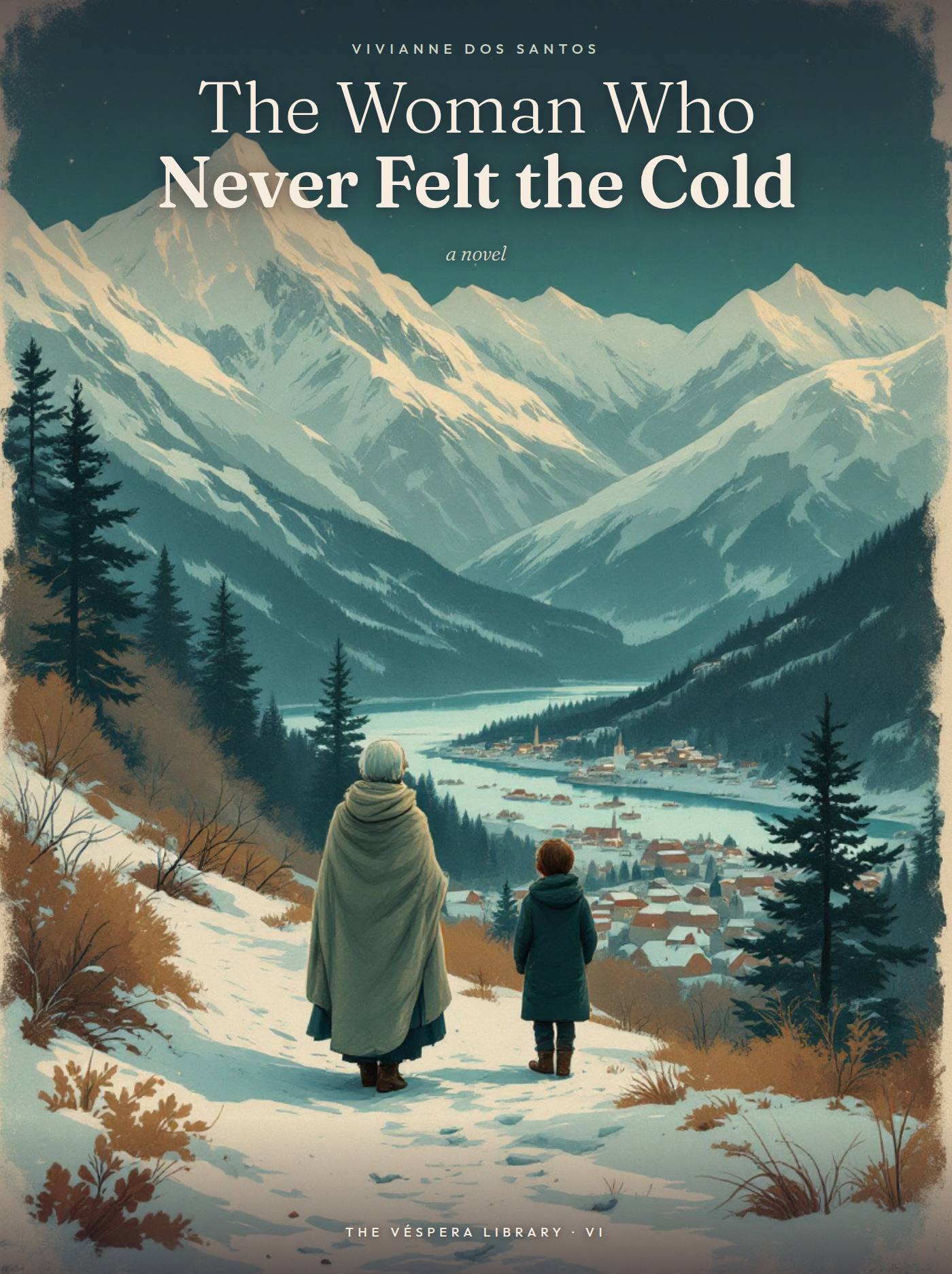
The Woman Who Never Felt the Cold
Serafina raised her siblings from the age of eleven, in the winter her parents went down the mountain and never returned, and she never cried. Everyone swears she does not feel the cold. But there is a winter, a granddaughter, and a blanket — and the words she says at the end, the first in sixty years: I always felt the cold after all.
A novel · 12 chapters, complete. Read the first one below; the whole book is in the shop.
From the register of Véspera
In the register of the village, in the part of the houses of the height, by the hand of the Keepers who passed through the book, is found:
Serafina, of the Serranos, of the house of the height. Daughter of parents who were lost on the serra in the Great Winter, and who are set down in this book with a line of death and no grave, because the snow never gave them back.
She was eleven years old in the winter when she was left alone with the small siblings. She raised them, married them off, buried those who went, and held the house of the height for sixty years, and in sixty years no one of the village saw her weep, nor be cold, nor need anything. For that they called her, and call her, the woman who was never cold.
The register says who was born, who married whom, who was lost in the snow. It does not say what it costs a girl of eleven to freeze everything she feels so that they do not all die, nor how long that ice takes to melt, nor that it takes, sometimes, a granddaughter and a whole winter for a woman to feel again the cold she always had. For that, books like this one are needed.
chapter one
The house of the height
On the serra, the cold is not a thing of the weather: it is a person. It comes at the end of autumn, settles in, and stays until the spring like a guest no one invited and who sits in the best chair, and the Serranos, the people of the houses of the height, learn from small to live with it, to respect it, to fear it, because the cold of the serra kills, and everyone of the height knows someone it took. So, in the houses of the height, the hearth is the heart, and it is lit early and put out late, and the firewood is gathered the whole summer with the winter in mind, and one who goes up the serra in the cold takes wraps double, for the serra does not forgive one who underestimates it.
Everyone, on the serra, is cold. Everyone except Serafina.
It must be said, before all else, that the legend of the woman who did not feel the cold was no nonsense of the village, no invention of credulous people: it was an observation, repeated over decades, of a thing everyone saw. Serafina, in fact, did not tremble. One would be at a winter funeral, in the churchyard, with everyone in coats and scarves, stamping their feet on the ground so as not to freeze, and Serafina there, in a thin shawl, straight, without a shiver, as though the cold that made everyone suffer simply did not reach her. She worked in the field, on the height, on days when no one else left the house, with her bare hands in the frozen earth, and did not complain, did not rub her hands, did not seek the fire. She crossed the snowy serra to attend to a sick neighbour when no one else dared go out, and came back like one who comes back from a summer stroll. Over sixty years, the whole serra had accumulated proofs that Serafina did not feel the cold, and had made of her, with those proofs, the legend of the woman of steel, without ever suspecting that that was no gift, it was a symptom; that a person who does not feel the cold that kills others is not a stronger person, it is a person in whom something has switched off the body's alarm; and that what the serra admired as a superhuman virtue was, seen from within, the mark of a very human and very deep wound, that of one who had to switch off the feeling to survive, and never again switched it back on.
It was her legend, and it was true, or seemed so: Serafina, at seventy-four years old, went about in short sleeves when the others trembled in coats; she did not light the hearth except at the end of the afternoon, and more for the light than for the warmth; she slept with the window ajar at the height of winter; and when someone, shivering, asked her how she endured it, Serafina shrugged her shoulders and said she had never been one for cold, that the cold was for those who felt it, and went on with her life on the height as though the serra, with her, made an exception. The village held her a marvel, a woman of another temper, a serra woman of steel, and the younger ones looked at her with that frightened respect one has for people who seem made of a matter harder than ours.
It was to this house of the height, and to this woman who did not feel the cold, that Neves came up, in the first cold of that winter, to spend the season with the grandmother.
Neves was of the city. She was Serafina's granddaughter, daughter of a son of Serafina who had gone down to the city when young, as so many serra folk went down, and who had made his life there, and Neves had grown up on the asphalt and the central heating, and of the cold she knew only what one crosses between the door of the house and the door of the car. She came to the serra for a reason of her own, that at first she did not tell the grandmother: she was going through a bad time, a misencounter in the city, a job that had not worked out, a love that had come undone, one of those times of life when a person needs to leave the place where they are to understand where they want to be, and someone, in the family, had remembered that grandmother Serafina was ever older and alone on the height, and that perhaps it would do both of them good, the old one and the young one, to spend a winter together. And Neves, who had no better place to go, came up.
She came up on a November afternoon, with the first real cold, and arrived at the house of the height shivering inside her city coat, which on the serra warmed nothing, and found the grandmother at the door, in short sleeves, chopping firewood, as though it were summer.
"Grandmother, are you not cold?" was the first thing Neves said, before the kiss, before everything, because the cold was the first thing her body felt and the grandmother in short sleeves was the first thing her eyes saw.
"I was never cold, my girl," said Serafina, and laid down the axe, and embraced the granddaughter with strong arms that did not seem those of a woman of seventy-four years. "Come, come in, for it is you who come frozen from the city. I will light you the fire."
And there was, in that first embrace, a thing that Neves only realised later: that the grandmother had embraced her with strength, but in an odd way, like one who is not used to embracing, like one who embraces out of duty and not out of habit, with the arms firm but the body a little rigid, without that abandon of the embraces of those who embrace much. And Neves, who came from the city where everyone embraces for everything and nothing, marvelled at that embrace of strong arms and rigid body, and kept it, without knowing yet that it was one more sign: that the grandmother did not quite know how to embrace, that she had the gesture but not the abandon, that she embraced as she did everything, with competence and without giving, and that that, an embrace without giving, was also the ice manifesting itself, because a real embrace is a giving, is to let the body soften against the other, and Serafina did not soften, neither embracing, nor ever, because to soften was to surrender and to surrender was, for her, the most dangerous thing in the world.
And she lit it. She lit the hearth for the granddaughter, with sure gestures, and in a short while the house of the height had at its centre its heart of fire, and Neves drew near to it, grateful, to thaw her hands, and noticed a thing she was to notice many times over that winter: that the grandmother had lit the fire and drawn away from it, that she had stayed seeing to her things far from the hearth, near the window ajar, in the cold, as though the warmth were a thing for others, a thing she made for those who needed it and that she herself did not need. The hearth was for the granddaughter. The grandmother did not warm herself at her own hearth.
The house of the height was like the grandmother: strong, bare, with nothing extra. Walls of thick stone, few pieces of furniture, everything in its place, everything functional, nothing superfluous, nothing of coddling. It was a house made to endure the winter, not to sweeten it, and Neves, used to the comfort of the city, felt at first a harshness in that, and only over the winter realised that the house was a portrait of the grandmother: a fortress, built to resist, where everything that was frail or superfluous or soft had been put aside long ago, because on the serra, and in the life of Serafina, the frail did not survive.
The first days at the house of the height were, for Neves, a learning of silence. In the city, Neves lived surrounded by noise, the traffic, the voices, the telephone always vibrating, and the noise had been, she realised it now, a way of not hearing herself, of covering with sound the misencounter that brought her to the serra. At the house of the height there was no noise at all: there was the wind, the crackling of the firewood in the fire, the deep silence of the snow, and in that silence Neves went on hearing, little by little, herself, and what she heard was not pleasant at first, because they were the questions she had come down to the serra to flee and that the serra, with its silence, gave her back whole. Why the love had come undone. Why the work had not worked out. Why she, at twenty-six years old, went through life like one who goes through a corridor in search of a door they do not find. The serra did not answer these questions, but it also did not let them flee, and Neves realised, in the first days, that she had come to a place where she was going to have to face them, and that perhaps it had been for that, at bottom, that she had come, though no one had said it so.
And there was the grandmother, that presence of stone that was, herself, a question. Neves spent the days observing her, with the curiosity of one who has little else to do and with the fascination of one who recognises, in the other, an enigma like their own. Because Neves, in her new and urban way, was also one who did not feel, or who had learned not to feel: the misencounter of the city had left her functioning cold, doing the days out of habit, not weeping what there was to weep, enduring on her feet as though to endure on one's feet were the only thing one can do. They were, the old one and the young one, two frozen ones, each of her own ice, each of her own serra, and Neves did not yet know, in those first days, that she had come up to the house of the height not only to help the grandmother thaw, but to thaw too, and that the two of them, without planning it, were going to warm one another over that winter, the old one teaching the young one that one is always cold, the young one teaching the old one that the cold can be spoken.
That first night, by the hearth, Neves warming herself and Serafina sitting a little apart, mending a sock by the light of the fire more than by its warmth, Neves looked at the grandmother, at that woman of seventy-four years, strong, dry, in short sleeves in the cold of the serra, and asked herself the question that was to occupy her the whole winter, and that was a real question, not a manner of speaking: what is a woman who does not feel the cold? How does one come to not feel the cold? No one is born without feeling the cold. The cold is felt, it is of the body, it is of everyone. A woman who does not feel the cold is a woman to whom something happened, somewhere, that switched off her feeling, and Neves, looking at the grandmother by the light of the fire, with the curiosity of young people and the intuition of those who are, themselves, trying to understand themselves, sensed that beneath the legend of the woman of steel there was a story, and that the story had to do with the cold, and that she, that winter, might come to dig it up, without knowing yet that in digging up the grandmother's story she was also, without meaning to, going to warm herself, who had come down to the serra frozen in a way that was not that of the body.
In the first days, Serafina showed Neves the serra, and it was on those walks that Neves began to understand the grandmother. Serafina knew every span of the height: she knew where the water sprang even in the ice, what herbs were gathered for which ill, where the wolf passed in the winter, what cloud brought snow and which only brought cold, and she taught all this to the granddaughter with a dry competence, without tenderness but without impatience, like one who passes on a knowledge that can save a life, which on the serra is what knowledge is. And Neves noticed that the grandmother, on those walks, never complained: she did not complain of the cold, nor of the weariness, nor of the climb that already cost her at seventy-four, nor of the knees that Neves heard her crack. She went about the serra as though the body had no right to complaints, as though to complain were a weakness the serra did not forgive, and Neves, who in the city complained of everything, of the cold, of the weariness, of life, saw in that woman who complained of nothing not a virtue to imitate, but a warning: a person who complains of nothing is a person who has switched off the complaining, and to switch off the complaining is to switch off the feeling, and to switch off the feeling is a way of no longer being quite alive.
There was one walk, in the first week, when they passed by some high crags, and Serafina stopped, and looked at a place on the slope, and Neves realised, by the grandmother's face, that that place had a story. She asked, and Serafina said only, with the dryness of custom, it was hereabouts that my parents used to come up, from the village to the height, and went on, with nothing more, and Neves realised that she had passed, without knowing, by the path where the great-grandparents had been lost in the snow, and that the grandmother passed there, silent, perhaps every week, for sixty-three years, without ever allowing herself to stop and feel what that place kept. And she kept that, the crag, the path of the parents, as one more sign of the ice, and she sensed that that winter, perhaps, she was going to have to go back to that place with the grandmother, and that that time perhaps the grandmother would stop, at last, and feel.
And Serafina, from her place apart from the fire, mended the sock, and did not feel the cold of the serra that came in through the window ajar, and did not know, yet, that there had come up to the house of the height, that winter, the only person in the world capable of making her feel, at last, after sixty-three years, the cold she swore she did not have.
· end of the sample ·