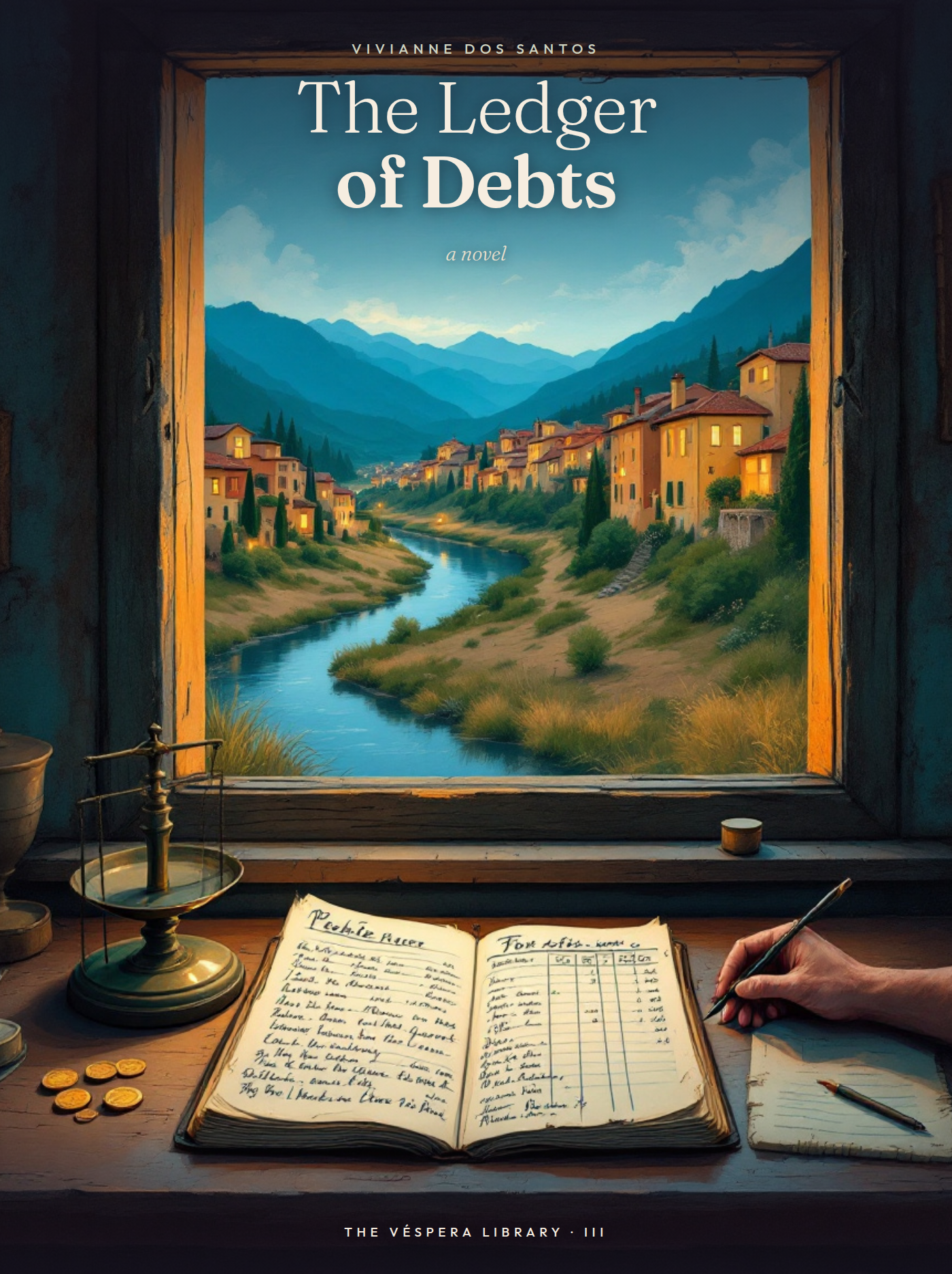
The Véspera Library · novel three
The Ledger of Debts
Benvinda inherited the shop and the ledger where the whole village is in debt to her. She knows by heart what everyone owes and has never charged a soul. This is the year she learns, late and with a trembling voice, the difference between being kind and being fair.
A novel · 12 chapters, complete. Read the first one below; the whole book is in the shop.
From the register of Véspera
In the register of the village, by the hand of the Keepers who passed through the book, is found:
Benvinda, of the house of the Grocery. Daughter of Abílio, the grocer, who inherited the shop and the ledger, and of the shop and the ledger made her house and her sentence.
The name was a promise, like almost all of them: she was born in a year of good harvests, with the larder full and the door open, and the father wanted the name to say what he felt at the coming of everyone. Benvinda. Welcome you be.
The register says who was born, who married, who departed. It does not say who owes whom, nor what it costs one who pays, nor what is silenced by one who forgives. For that there are other ledgers, and this is one of them.
chapter one
The ledger
The Grocery stood on one of the corners of the largo, between the house with the window and what had once been the telephone post, and it had above the door a wooden sign so old it could no longer be read, and beneath it the smell, which was the true sign: the smell of the coffee yet to be ground, of the salt cod, of the blue soap, of the lamp oil, of the bread, all mixed in a single smell that was the smell of the Grocery and no other in the world, and that the village carried in its memory even before going in. Whoever was born in Véspera was born knowing that smell. Whoever left for elsewhere carried it, and came back years later and it was the first thing they recognised, before the faces: the smell of Benvinda's shop, which was the smell of her father's shop, which had not changed in a hundred years because the things that are sold do not change and the way of keeping them does not either.
Benvinda's Grocery opened before the bell, because the hunger of the fields does not wait for the hours.
It had been so since the time of the father, and since a time before the father that no one remembered any longer: the door unbolted when the serra was still a shape lying down, the lamp lit behind the glass, and Benvinda at the counter, in her apron and with a pencil behind her ear, waiting for the first ones, those who went out to the land with a hoe on the shoulder and took the bread and the tobacco and a word before the day. To those one did not sell: one gave, and noted it down. To sell, in the Grocery, was a thing that happened later, when the outsiders came in or those who paid on the spot, and it was almost a rudeness, a serious bit of business in the midst of a house of friends.
The ledger lived under the counter, in a black oilcloth, and it was older than Benvinda. It had a cover of thick board, the corners rounded from so much turning, and inside, page after page, the whole village in columns: the name on the left, the date in the middle, what was taken and what was paid on the right, and beneath almost everything, the line. The line was the soul of the ledger. To strike out was to forgive. Benvinda had learned to strike out from the father, and the father from the grandfather, and the village of Véspera knew that a debt at the Grocery was not quite a debt: it was a way of the house saying that it trusted, and the line was the way of saying that it went on trusting even after knowing it would not be paid.
That October morning, the first to come in was the miller's widow.
"Benvinda."
"Come in, woman, it is cold."
The widow took half a kilo of beans, a piece of bacon and a candle, and stayed at the counter telling, as she told every morning, of the leg that did not let her sleep and the son who did not write. Benvinda heard her out whole, for to listen was also a wares of the house, and when the widow made as if to look for the coins in the knotted handkerchief, Benvinda already had the pencil in her hand and the ledger open.
"Leave the handkerchief. I am noting it."
"You always note it."
"I always note it." She wrote, in her hand, which was small and straight: the beans, the bacon, the candle. She did not write the extra price she had put on the bacon, because there was no extra price: the scale of the Grocery, when it weighed for the miller's widow, always leaned half a finger to the customer's side, and Benvinda corrected it with her thumb like one who strokes an animal. "Go with God, the cold is sharp."
The widow went, and behind her came the others, their whole morning: the Marçais boy, who always took tobacco and never money; the mother of the twins, who paid a week and owed three; old Aprígio, who came in only to warm himself and went out with a loaf he swore he would pay for on the day of his pension, eleven years ago. Benvinda noted it all, in the ledger, with the patience of one who waters a field knowing they will not reap it. And when, in the middle of the morning, in came Amparo of the Olive-Press House, silent and straight, with her money folded in four in her pocket, and laid the notes on the wood and said only strike it out, Benvinda struck it out, and stayed with the pencil in the air watching her leave, and said to her, at the door, what she had said to that woman for years without either of them changing their behaviour because of it:
"One who owes never knew what it costs. And one who pays never owed anything."
The phrase stayed in the air of the shop after Amparo had gone. Benvinda knew it by heart, said it well, saw it clear as the glass of the counter: she saw Amparo paying for thirty years the debts of her son and spending herself on them, she saw the whole imbalance of that account. She saw all the imbalances of the village with the sharpness of one who is on the outside of the counter. What she did not see, or saw and pretended not to, was that the whole ledger, from the first page to the last, was the imbalance of her own self, written in her own hand, year after year, and that no one, in three generations, had ever said to her the phrase she said to everyone.
Between the widow and noon almost the whole village passed through, and Benvinda attended to it like one who says a rosary, each account a current account of the heart before being of the money. The mother of the twins came, who paid a week and took three on trust, and told that the eldest had a cough, and Benvinda put in her bag, without noting it, a jar of honey for the boy's chest, because honey for a cough is not charged, it is of the house. Old Aprígio came, who came in rubbing his hands from the cold and asked for a loaf and tobacco, and swore, as he swore every morning for eleven years, that he would pay for everything on the day of his pension, and Benvinda noted the loaf and the tobacco beneath the other eleven seasons of loaves and tobaccos, in the old man's long column, which was among the longest in the ledger and the one she with the most tenderness struck out entirely from time to time, when the page no longer fit. The Marçais boy came, who took tobacco and not money, and did not even take the trouble to lie that he would pay: he held out his hand, received, and went out, in the calm certainty of those who were born knowing that the Grocery is free. Benvinda noted his tobacco without a word, but that time, on writing the Marçais name, her hand lingered an instant longer, as though the name weighed on her, and she could not yet say why.
It was that morning, at noon, with the shop empty for the first time, that Aurora came in.
She came in as Aurora came in everywhere: quickly, looking at everything, with the briefcase under her arm and her head already three things ahead of her body. She was the niece, daughter of Donato, the middle brother, who had moved away to near the City long ago and sent news by telephone. Aurora had been the first in the village to study away, and the village still said it with that mixture of pride and of fright it kept for the things it admired without understanding. She was forty-one years old, had a city coat, and a way of being that was that of one who never arrived anywhere because each place is only the step to the next. She had come back to Véspera for a few weeks, to see to the sale of her share of her father's house, and had settled in at her aunt's, at the Grocery, because the aunt had rooms to spare and no one to say no to.
"Aunt."
"My girl. Have you eaten?"
"I ate on the road." Aurora laid the briefcase on the counter, beside the black oilcloth, and the two of them rested there like two worlds: the old board ledger and the briefcase with the metal clasp. "Aunt, I was looking at your things today. At the shop papers, while you were serving."
Benvinda, who was tidying the tinned goods, did not turn at once.
"My things are all in order."
"They are." Aurora opened the briefcase, and from it took a new notebook, smooth-covered, with a pen clipped to the ring, and Benvinda looked at that clean notebook like one who looks at a doctor's instrument. "They are so in order that I managed to copy it all. The names, the dates, what was taken, what was paid. I spent the morning on it, aunt, because I cannot bear to be without doing sums, it is a fault of mine, my father says I count the steps of the stairs. And I asked your ledger a question that perhaps no one ever asked it."
"What question?"
Aurora laid the new notebook open on the counter, turned toward her aunt. On a single page, in clean columns, was the whole Grocery reduced to a number, at the bottom, underlined twice.
"How much does all this owe you, aunt. Exactly. All added up."
Benvinda lowered her eyes to the number, and the number was large. It was a number she had never seen, because her ledger had no page bottoms nor sums: it had names, and names do not add up. Each line of the ledger was a face, a story, a cold morning, a widow, a boy, an old man warming himself. Put all together in a column, faceless, they turned into that: a large number, beneath a double line, saying what the village owed her exactly.
"That does not add up like that," said Benvinda, and went to fetch the cloth to wipe the counter that was clean.
"It adds up like that, aunt. It is exactly like that that it adds up." Aurora had no malice in her voice, she had worse: she had clarity. "You give on trust to the whole village, and the whole village owes you this. And you buy from the wholesaler in the City, who gives on trust to no one, and you have to pay him in cash. Do you see the problem? You are the only place between the village and the city where the money comes in and does not come out again. It is a well, aunt. The Grocery is a well where the village throws what it needs and no one pulls the rope."
Benvinda passed the cloth slowly. Out there, in the largo, the dry fountain composed itself in the weak October sun, and an ox-cart passed, slowly, with that creaking that was the clock of the village. Inside the shop, the large number was on the counter, beside the old ledger, and the two notebooks looked at one another like two ways of telling the same life.
"Your grandfather," began Benvinda, and stopped. She was going to say one thing and said another: "Your grandfather used to say that a shop that collects is a shop that loses friends."
"And how many friends does the shop have, aunt, now that it is nearly closing?"
It was said without cruelty, and so it hurt more. Benvinda laid down the cloth. She looked at her niece, at that girl who had left the village and come back with outsider's eyes, eyes that saw the number and did not see the face, and she had, at the same time, a wish to send her home and a fear that she might be right.
"The shop is not closing."
"Aunt." Aurora pulled up the stool and sat down, and lowered her voice, and for a moment she was not the girl of the sums, she was the niece. "I saw the wholesaler's papers. I saw the letters you keep in the drawer and do not open. They have already sent word twice. You owe them almost as much as the village owes you. Only they collect, and you do not. And when two people owe one another and only one collects, do you know who is left with nothing?"
Benvinda knew. She had said it that morning, to Amparo, at the door. One who pays never owed anything. Only she had always thought it of others, and never, in sixty-one years, had she thought it of herself.
She did not answer. She went to the drawer, the one she did not open, and took from it a bundle of papers held with an old elastic, and laid them on the counter, beside the two ledgers. They were the wholesaler's letters, the last ones unopened, with the City postmark and the typed letters, cold, that knew no one by name. Aurora looked at the bundle, and then at her aunt, and had the good sense to say nothing more.
"Come and eat," said Benvinda, at last, and the voice came out older than it had in the morning. "I made soup. We will speak of this with a full belly, for on an empty belly the sums all come out crooked."
They went up to the house, behind the shop, and the Grocery stayed shut at lunchtime, with the lamp out and the three ledgers on the counter waiting: the old one, of board and of names; the new one, of Aurora, with the large number; and the bundle of letters from outside, which had no ledger at all, only debt, only the clean cold of one who collects from one they do not know.
The soup had been made since the day before, for Benvinda made a pot for two days, and they ate it at the table of the upstairs kitchen, the same where Benvinda's mother had turned her skirt and watched over the accounts. Aurora ate quickly, as she ate everything, with the clean notebook still under her arm, and Benvinda ate slowly, looking out the window at the roof of the churchyard and at the serra in the distance, and for a while neither of them spoke, because the large account was upon them and the two of them circled it without daring to touch it at the table.
"Your mother," said Benvinda, at last, more to delay than to say, "liked this soup. Your mother, when she was alive, came here to help me in the shop on Saturdays, and always said to me the same thing: Benvinda, you give too much. And I laughed. I thought it was a compliment. You see how a person can hear a truth a whole lifetime and take it for a compliment?"
"Mother said that to you?" Aurora laid down her spoon. They spoke little of the mother, in that family, who had died young, and Aurora seized any crumb of her like one who seizes a portrait.
"She did. And your father says the contrary, that I do not collect because I am a fool, that if he had kept the shop he would be rich by now. The two of them are right, my girl, that is what is funny. I give too much and I collect nothing, they are the same thing seen from two sides, and your mother saw it with pity and your father with anger, and neither of them changed me, because to change a person it is not enough to be right about them." Benvinda raised the spoon to her mouth, slowly. "You, now, are right too, with your number. And I know you are. The difference is that you brought the rightness inside a paper that says the shop closes. And against a paper like that, my girl, there is no longer an ear that can play deaf. It is the first time in my life that my way of being has a date marked to end. Six weeks. Perhaps that is what makes me hear you when I did not hear your mother nor your father: they brought me reasons, and you bring me a deadline."
Before going down, she stayed a moment more at the window of the upstairs kitchen, looking out at the largo, and Aurora came to stand beside her, and the two of them looked, silent, at the village in the middle of the afternoon: the dry fountain, the houses, the roofs, the serra in the distance. And Benvinda, without turning, said a thing that was for herself more than for her niece:
"I know them all, my girl. At each door of that largo I can tell you who lives there, what they eat, what they owe, on which foot they limp. Sixty-one years watching them come through my door. And yet, sometimes, I get the feeling that I know none of them, because I see them only from one side, the side of the one who gives. I never asked them for anything. A person of whom we never asked anything is a person we do not know at all, it is a river we only ever saw running one way." She sighed. "Perhaps this year I am going to have to ask them. And perhaps I am going to come to know them for the first time, all of them, at sixty-one. And I am afraid, Aurora, of what I am going to discover. I am afraid of discovering that the village I have loved my whole life only loved me on a full belly."
And in the afternoon, when she went down to reopen, and the miller's widow came back, this time on account of a needle, Benvinda took up the pencil, and for a second, only one, her hand stayed suspended over the ledger without knowing whether it was going to note it down or whether it was going, for the first time in her life, to say a number aloud. She noted it. Of course she noted it. But the suspension had existed, and that was new, and Benvinda kept it without knowing that she was keeping the first seed of the year to come: the year in which she was going to have to learn, at sixty-one, to say to herself the phrase she said to the whole village, and to discover, with her voice trembling and the ledger in her hand, how much it cost her, after all, to be so welcome to everyone.
· end of the sample ·