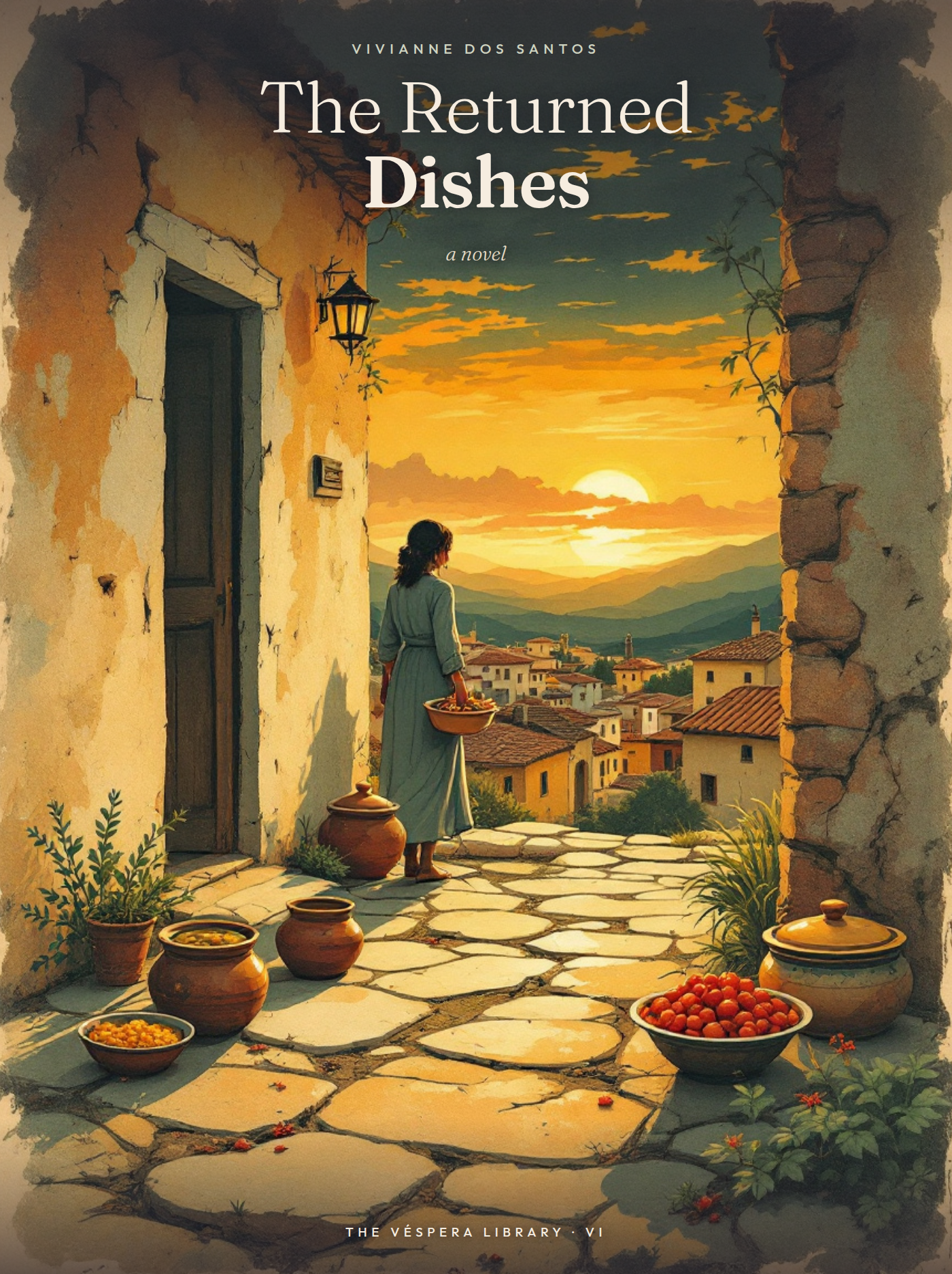
The Véspera Library · novel twenty
The Returned Dishes
Socorro was everyone’s help her whole life: the one who comes, who shelters, who is there when someone needs. But when she falls ill, and the village does what the village does, dishes of food at the door, she returns them full, with a note of thanks, because to count on someone, once, in the year she most needed, ended at the empty door. This is the year she learns the hardest thing for one who only knows how to give: to accept the first dish, to eat it to the end, and to return it empty, which in Véspera is the greatest declaration of trust there is.
A novel · 12 chapters, complete. Read the first one below; the whole book is in the shop.
From the register of Véspera
In the register of the village, by the hand of the Keepers who passed through the book, is found:
Socorro — help, succour — daughter of the village, and the name was a wound set in baptism.
They called her Socorro, the one who comes to the rescue, and she fulfilled the name her whole life, being the help of others, the one who shelters, the one who is there when someone needs; but the name, which was for giving, turned against her, because the one who is the help of others learns to give and never to receive, and Socorro, who came to everyone's rescue, did not know, when misfortune struck her, how to let them come to hers.
The register keeps who gives and who receives, who comes to the rescue and to whom one comes. It does not say why there are those who return full the dishes left at their door, nor what year it was in which she counted on someone and was left looking at the empty door, nor what it costs, after that, to eat the first dish and return it empty, which in Véspera is the greatest declaration of trust there is. For that, books such as this one are needed.
chapter one
The help of others
Socorro woke with the village still asleep, and the village, still asleep, was already counting on her.
It had been so always, or since an always so old she no longer remembered its beginning. The sound of hurried steps on the upper path, at an odd hour, was enough for her to be on her feet before the thought arrived, hunting for her coat in the dark, and she was rarely wrong: steps at that hour meant trouble, and trouble in Véspera had a name, and the name was hers. Socorro — the one who comes to the rescue. They had set it on her at the font the way one sets a tool in a child's hand, and she had taken it up and never let it go.
That night before dawn it was Felismina who came knocking, Aníbal's daughter-in-law, bare on one foot, her kerchief badly tied and her breathing all ahead of her words.
"Socorro, it's my mother-in-law, she's bringing everything up, and the blood, Socorro, there's so much blood."
Socorro was already at the door with the oilcloth bag under her arm, the same that had been her mother's, and she went down the path ahead of Felismina without asking for any more explanation, because the explanations were given by the sick body, not by the mouths of the frightened. She found old Custódia — keeping — face down on the kitchen floor, beside the dead fire, and knelt right there on the cold tiles, and did what the hands knew: turned her on her side, cleaned her mouth, spoke low in her ear the way one speaks to someone halfway through departing who can still be called back. She stayed with her until the doctor arrived from the big town, three hours later, and by the time the doctor arrived the old woman was already breathing straight and had her head on a pillow that was not hers: it was the pillow that Socorro had run home to fetch, in the middle of the night, because the floor was hard and the old woman deserved to reach the morning with her head on something soft.
The doctor, on his way out, asked her who she was, and Felismina answered before her, with that pride the village had in her and that was also, without anyone knowing it, a chain:
"It's Socorro, doctor. It's Socorro, who comes to all our rescue."
Socorro gathered up the pillow, gathered up the oilcloth, gathered up herself, and went up the path with the first light being born behind the mountain. She carried nothing. That was the rule, the one she had never told anyone because she had never needed to tell it, so deep it lay: one went with full hands and came back with empty hands, and it was right, and that was how it had to be, because she was the one who gives. Felismina ran after her with a dozen eggs in a cloth, still warm, insisting, take them, Socorro, take at least the eggs, and Socorro closed her fingers around the cloth with a gentle firmness and said what she always said, the sentence worn thin from so much use:
"Keep that for your mother-in-law, who is the one who has to make new blood. I manage on my own."
I manage on my own. This was the sentence. She would hear it, later, in the mouth of a Keeper, said the other way round, the way one says a sentence of judgment. But that morning it was only what she thought it was: good sense, manners, the right way for an upright person to be in the world. She went up the path, opened the house windows to the east, lit her own fire, and no one came to know that Socorro had spent the night on the floor of another kitchen, because Socorro did not tell what she did, the same way her mother had never told what she had told to hers, and so on, in a chain of silent women who gave in the dark and died without anyone knowing their weight.
Days before, it had been a birth. Lequinha, the youngest of the blacksmith's daughters, was at her hour, and her man came to call her, a frightened young fellow who hardly knew what to say, and Socorro went down the path ahead of him with the oilcloth bag and was with the girl the whole night, trimming back her fear, saying in her ear breathe, child, let the body do it, it knows, you have only to let it; and the boy came at dawn, sound, bawling, and Socorro put him to his mother's breast and saw to the house, and washed what there was to wash, and left it all clean and the water heating on the fire for when the girl woke. And Lequinha's mother, who had come running in the morning, wanted to give her a folded note, take this, Socorro, for the night's work; and Socorro closed her hand around the note and said the usual thing, keep that for the boy's layette, which is what's wanting, I take nothing from a birth, never have. And she went up the path with empty hands, the dawn at her back, without having eaten, without having slept, and went home to make her day as though the night had not existed. That was how it was. She went down full and came up empty. And it never once crossed her mind, in forty years of births, that that coming up empty, which she held to be a virtue, was the exact drawing of her sickness: the woman who gives life to half the world and goes up the path alone, before dawn, without letting a single folded note, a single warm egg, a single hand, fill her hands back up again.
Because this was what no one saw, beneath the giving: that Socorro gave with both hands and shut both hands when someone wanted to fill them. And it was not for lack of need. She needed as everyone needs, the warmth of a hot dish on a winter night, a hand on the back on a bad day, someone who would ask her, once, just once, and you, Socorro, how are you. But when the hand came, she slipped aside. When the dish came, she returned it. When the question came, she answered it with the question back, and you, how are you, which is the most polite way there is of not answering.
She remembered, for example, the time of Rosalina's birth, the miller's daughter, which came too early and badly. Socorro was with her from noon to midnight, trimming back the girl's fear and setting the girl's mother, who was getting flustered, to boil more water than would ever be needed, only to give her hands something to do. When the boy was born, sound, bawling, Rosalina, spent and happy, gripped her wrist with a strength that did not seem her own and said:
"Socorro, I'll never be able to repay you for this."
And Socorro, who should have said it's all right, child, there's nothing to repay between us, said something else, without noticing what she was saying, because it was what always came out of her:
"There's nothing to repay. I don't give in order to receive."
It was true, and it was lovely, and it had beneath it a poison Socorro would only come to taste many years later: because whoever does not give in order to receive ends, without meaning to, by saying also that she does not receive. Whoever shuts the door on the bill shuts it, in the same gesture, on the embrace. And Rosalina was left with her gratitude stuck fast, with nowhere to put it, because Socorro would not let her set it down anywhere, and gratitude, when it has nowhere to rest, weighs on the one who feels it, and so it was that Socorro, without ever asking anyone for a thing, left the whole village in debt without a debt, grateful without being able to be grateful, bound to her from above and at a distance, on the clean surface of giving, and alone with her beneath, where receiving lives, where intimacy lives, where she never let anyone in.
And there was, in this house, a daughter who saw all this from closer up than anyone, and who suffered within what the village admired from without. Glória — glory — lived three houses away, and came every day, and every day struck, without knowing it, against that wall; she brought things, she offered herself, she wanted to come in, and her mother thanked her and shut the door. Once, newly married, Glória had said to her husband, at night, in their bed, a thing she had never said to anyone else: my mother loves the whole village and leaves me at the door. Everyone has from my mother a night on the kitchen floor, a broth, a wake; I, who am the daughter, have not even that she'd let me bring her a soup when she's down with a cold. And the husband, who was a good man but from away, had said to her don't exaggerate, woman, your mother is a saint; and Glória had fallen silent, because that was the curse of the thing, that from outside the mother really was a saint, and that the daughter, in complaining of the saint, seemed ungrateful, and was left with no way to explain to anyone that one can have a mother who gives to half the world and to her own daughter lets her give nothing, and that this, far from being saintliness, is a door shut with the face of virtue.
And she remembered, from those weeks, the death of old Aníbal, Felismina's father-in-law, who in the end did not hold on, and was buried three days after the night Socorro had found him on the floor. It was Socorro who shrouded him, as she had shrouded half the dead of Véspera over the last forty years, because she had a way with the dead that few have, a way of closing their eyes and composing their hands on their breast and straightening their mouth so that they seemed to have departed in peace, even those who had departed in suffering. She worked over him slowly, alone in the room, speaking low to him as to the living, and when she came out, the man already composed and dignified on the bed, the house was full of people and of the smell of coffee and rosemary, and Felismina, red-eyed, wanted to set a plate in front of her, eat something, Socorro, you've been here since morning with nothing in your mouth. And Socorro refused. She refused in the middle of a house of mourning where everyone was eating, refused on her feet, with her apron still smelling of the death she had just composed, I'm not hungry, child, see to your own, who need it, I eat at home; and she went off into the night, with empty hands, without having eaten or drunk, and no one thought it strange, because it was Socorro, and Socorro was like that, she gave and did not take, and the village held that to be a virtue and did not see that it was the reverse of virtue, fear dressed up as strength. She ate, on reaching home, a hunk of dry bread leaning against the sink, alone, at midnight, with the hunger she had refused at others' tables; and she went to bed, and did not even notice that she had done what she would do her whole life, give food to half the world and eat alone the dry bread, on her feet, in the dark, without letting a single hand set a hot plate in front of her.
She was fifty-five years old that winter, and her body had begun to warn her. It warned her in the morning, with a stiffness in the knees going down the path; it warned her at night, with a tiredness that was no longer the good tiredness of one who has made her day, it was a tiredness from underneath, with no bottom, that sleep was not enough to fill. One afternoon, getting up quickly to go to the rescue of someone calling, the kitchen spun around her, and she had to hold on to the stone of the sink, and she stayed there a moment, gripping the cold stone, with her heart beating in her ears, hearing, for the first time in her life, a sentence that terrified her more than any trouble of others: one day it's you. One day it's you who'll be on the kitchen floor, and who is there to come to your rescue.
She pushed the sentence away as one pushes a door against the wind. She told herself within that no, that she could bear it, that as long as she had her feet under her it would always be she who went down the path, never someone who came up to fetch her; and there was in that no a strength, and there was beneath the strength a fear so old it no longer knew its own face, the fear of being on the other side, the fear of being herself the sick one in the bed, watching the village at the door looking at her in her want, having to do the one thing she had never learned to do and that no other village would forgive her for not knowing: to receive.
And there was a thing that Socorro had never said to anyone and that was the sum of everything: that she did not know, truly, how to say thank you. She knew how to thank with manners, with formulas, God repay you, it wasn't needed, you're very kind; but to say thank you in earnest, the thank you that admits that one needed, that one received, that another reached where one could not reach alone, that one would not come out of her, it stuck in her throat like a bone. She wrote them, yes, the thank-yous, on the little notes of the dishes returned full, but they were thank-yous that said the opposite, thank you but no, thank you but take it back, thank you but I don't need you; thank-yous that were doors shut with care. And she herself did not notice it, she thought herself the most grateful woman in Véspera, she who thanked everyone at every hour; and she did not see that to thank with the mouth and shut the door with the hand is the most polite way there is of not receiving, and that her notebook of thank-yous, in fifty-five years, did not have a single one that meant what the word means, which is, at bottom, I received you, I needed you, I'm glad you came.
And there was a day, at the start of this book, on which the body stopped warning and began to compel. It was a morning on which Socorro could not get up. It was not vertigo, it was not the spinning of the kitchen; it was a fever that fell on her like a roof tile, and a weakness in the legs that would not let her set her feet on the floor, and a deep cough that tore her chest down the middle. She lay there, looking at the ceiling, listening to the neighbour's cock crow the morning she would not be able to keep, and understood, with a nameless dread, that there was no one she could not call: because the village would know, the village always knew, and when the village knew, it would come down the path she had so many times gone down the other way, and would knock at her door, and would put at her door what she put at everyone's, and she would have to be, for the first time in fifty-five years, on the side of those who receive.
The first to know was Glória, the daughter, who came every day and who that morning found the door ajar and her mother in bed. And the second was the whole village, because Glória, frightened, told Aurélia, and Aurélia told Lucinda, and Lucinda told Benilde, and before noon it was known in Véspera what was almost impossible to believe and impossible not to believe at the same time: that Socorro, everyone's help, was abed, and needed.
And the village did what the village does, what Socorro herself had done for all her whole life. It came running. By the end of the afternoon there was already, on the stone bench at Socorro's door, the first dish, covered with a linen cloth, still steaming. And it was before that first dish, lying in bed, too weak to go and fetch it and too strong to let it in, that Socorro found herself, at last, facing the thing the whole book would ask her to learn, the thing she had given to all and never known how to take for herself: the help of others.
· end of the sample ·