The Véspera Library · novel twenty-two
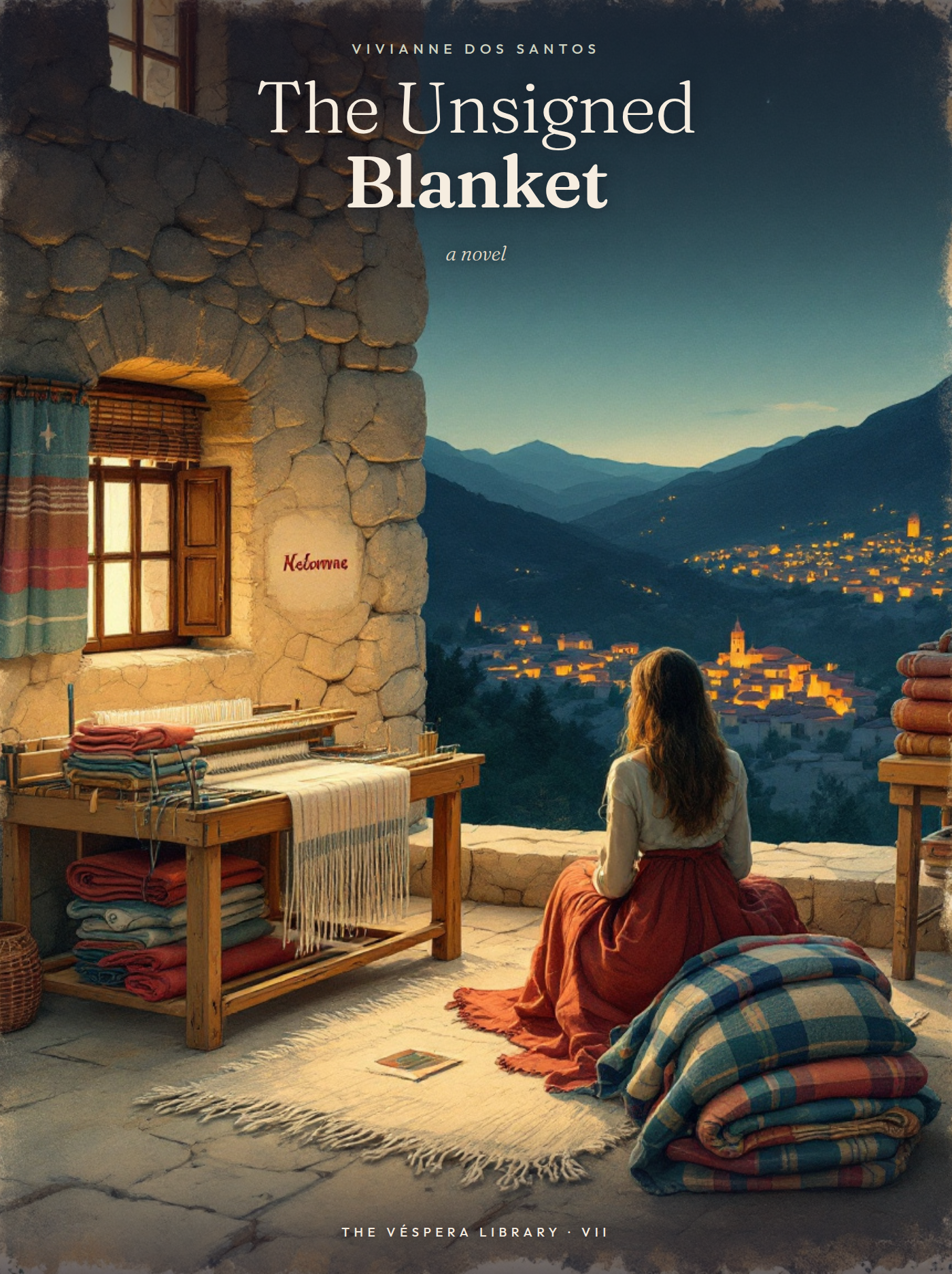
The Unsigned Blanket
Velada weaves the most beautiful blankets of the region, and half the village sleeps warm by her work without knowing it: she sells through an intermediary, refuses the fairs, does not sign. When someone praises a blanket before her, she changes the subject with her heart racing. The only time she showed herself, when young, with a prize-winning work, the envy that followed cost her her only friend, and she learned that to be seen was to lose. This is the year she learns to show herself without losing herself: the first signed blanket, the name embroidered tiny in the corner, then less tiny, and the discovery that what she creates deserves to reach the world with her attached to the name.
A novel · 12 chapters, complete. Read the first one below; the whole book is in the shop.
From the register of Véspera
In the register of the village, by the hand of the Keepers who passed through the book, is found:
Velada — the veiled one — of the Highlanders, weaver, and the name was a fate: they called her Velada, the covered one, the one who is under the veil, the one who does not show herself, and she fulfilled the name her whole life, hiding herself, veiling herself, making the most beautiful work of the region and not letting anyone know it was hers; and the name, which was only a name, became her way of being in the world, covered, behind what she did, without ever appearing.
The register says who made what, and what hands wove what. It does not say why that hand covered itself, nor what a beautiful work lacks when it lacks, in the corner, the name of the one who made it. For that, books such as this one are needed.
chapter one
The unsigned blanket
Velada's house was known from far off by its sound, not by the woman.
Whoever climbed the path of the Highlanders, in the dead hour of the afternoon, heard the loom before seeing the roof: the beat of the reed against the warp, the dragging of the shuttle from one side to the other, that cadence of an old breathing that came from the stone house leaning against the crag, and that was, to the serra, as certain as the river down below or the cocks at daybreak. The carriers who passed on their way to the big village knew the sound by heart, but they put no face to it. They said, as they crossed the path, there is the weaver at her work, and they went on, and they had never seen the weaver, nor did she want to be seen, because the loom stood at the back of the house, turned towards the crag and not towards the road, on purpose, so that the light would come in at her back and she would stay in the shadow, and whoever peered in from the door would see the blanket being born but not the hand making it.
And Velada's blankets were a rare thing, the whole region knew that without knowing whom it spoke of.
She had an eye for colours that no one else in the serra had. She knew how to draw from the indigo a blue that seemed to have night inside it, and from the onion skin a tired, warm yellow, and from the madder a red that did not shout, that lingered, and she joined them in stripes and in checks in a way that stopped whoever passed. Half the village slept warm under Velada's blankets, and people from the big village too, and even, it was said, a family of gentlefolk away towards the city who had sent for three at once; and none of those people, pulling the blanket up to their chin on a frosty night, knew that there was a woman, alone in the serra, leaning against a crag, who had woven that comfort with her hands. They bought them from a man, the Souto, who went up to fetch them and brought them down to the fair, and the Souto was the visible face of a work whose owner stayed hidden in the dark of the loom, without a name, without a face, without anyone tying that beauty to that woman.
And the red was the most hidden work of all, and the one that had most of her in it.
Velada drew it from the madder, which she sowed herself in a plot behind the house, facing south, far from the sight of whoever passed on the path. She pulled the roots at the end of the third summer, when they were strong, and dried them in the smoke, and ground them in a stone mortar that had been her grandmother's, and then came the part no one saw, the alchemy of the vat, in which the colour of a whole winter was won or lost. She set the water to heat without boiling, for if it boiled the red came out brick-coloured, common, and what she wanted was not brick, it was ember, it was the red that has ash inside it and is slow to go out. She stirred the vat with a rod, for hours, at the start of the morning, alone, with the smell of hot root filling the yard, and there was a certain turn of the colour, at a certain point of the water, at which she knew, without any thermometer, only by her eye and by the smell, that it was at the point, and at that turn she plunged the wool, and the wool drank the red slowly, and Velada stood watching it drink with a joy that was perhaps the only one she allowed herself without guilt, because the vat could neither praise her nor envy her, the vat only gave her back, in silence, the exact colour she knew how to ask of it. It was there, beside the vat, with her hands red to the wrist, that Velada was more herself than anywhere else, and it was on purpose that no one saw her do it, because even the joy of dyeing Velada dyed in secret.
And Velada wanted it so, and she worked at it every day, with method.
It was not absence of mind, nor the shyness of one who does not know how to speak. Velada knew how to speak when she had to, she was dry but clear, and she haggled the price of the thread with the dealer from Coja better than many a man. What she did not do was put herself beside what she wove. She refused the fairs, where she would have to stand at the side of the blankets, to sell them herself, to hear what was said of them with herself there in front; she preferred the Souto, who spared her from appearing. And she did not embroider the name in the corner, as the other weavers of the serra did, the Engrácia of the Valley, the late aunt Romana, who put their initials at a corner of the work, an R, an E, a small sign that said this one is mine. Velada's blankets came off the loom bare of any name, anonymous, and she wanted them so, because to embroider the name was to say it was I, and to say it was I was to appear, and to appear was the thing Velada did not do, for an old reason that dwelt at the bottom of her and that had, she knew it well, a date and a name.
And the price of all this, of the hiding, Velada paid without complaint, and it was a price that does not show and that for that reason seems smaller and is not.
She lived alone, in the serra, with the loom, and the life was beautiful in part, because the work was beautiful and she loved it, and there are few things so whole as a woman at the loom on a morning of good light, with the shuttle going and coming and the colour being born from her hands. But the life was poor in one thing, and the thing was great: in the encounter. Velada never saw the face of whoever slept warm under her blankets. Once, in a hard winter, she learned from the Souto that one of her blankets, one of the big ones, of more wool, had ended up in a poor house of the lower serra, with a widow with small children who spent the winter in a hovel of loose stone, and that the woman, on receiving the blanket, bought second-hand for almost nothing, had wept, because it was the first warm thing to enter that house in years, and the three children slept under it, together, and the woman said to the Souto, thank whoever made it, may God repay her, she does not know the good she did me. And the Souto, who told this as one tells a thing of little weight, did not understand that he was handing to Velada, by his own mouth, the greatest payment a craft can give, that of knowing that what we made was warmth to one who was cold, shelter to three children in the dark; and he did not understand, above all, that that thank whoever made it had no one to go to, because the one who had made it was hidden in the serra and did not want to be found, and the widow's thank-you stayed in the air, without destination, as they all stayed. And Velada, on hearing, felt the joy and the sadness of always quarrel in her breast: the joy of having warmed three children, and the sadness of having done it with her back turned, without a face, without a name, without ever being able to go to that poor house and say it was I, and stand at the door watching the children warm, which was the only payment she had, deep down, always wanted and never let herself have.
And the others, who knew her from afar, thought her humble, and praised her for it.
Ah, the Velada, said Benvinda of the grocer's to whoever asked about those blankets, she makes that and doesn't even boast of it, doesn't even put her name to it, she's of a modesty there's no more of. And Velada, when the echo of those sayings reached her, let them run, because it was easier to pass for modest than to show what was underneath, which was no modesty at all. Modesty is not to mind being seen. Velada minded it utterly. What she had was dread of it. Velada's hiding was not the peace of one who pays no heed to the eyes of others, it was the flight of one who fears those eyes as one fears a dog let loose, and that too she hid, beneath the fame of being humble, because even her fear Velada veiled. It was her name and it was her craft: to veil. To cover. To lay the cloth over the top.
But there was one afternoon, at the start of this book, on which the cloth slipped from her, and she saw what went about underneath.
She had come down to the village over an order of wool, a rare thing, for she almost always sent the Souto to see to that too, but the Souto was down with a fever and the wool would not wait. She was in Benvinda's grocer's, at a corner, waiting for them to weigh out her thread, with her kerchief drawn tight like one who does not want to be spoken of, when there came in two women from the big village, weekend strangers, of the sort that climb up to the serra on a Sunday. They carried a blanket folded over the arm, bought at the fair, and they came along discussing it as one discusses a thing held dear.
"Look at the colour of this," said one, opening a corner of the blanket on the counter, right beside Velada, with no idea. "See this red. This is no dye from away, this is plant, this is the hand of one who knows. I've seen many a blanket and I never saw the like."
"And the make of it," said the other, passing her palm over the warp. "Notice how the stripes don't match up, on purpose, it's on purpose, it's so the eye doesn't tire. Whoever made this wasn't doing it to sell. It was for love."
"Who would have made it?" said the first, turning the blanket about in search of a mark, of a signed corner, and finding none. "It has no name. So lovely and with no name. She must be an artist, some old woman up there in the serra who's dead by now, maybe, and nobody ever got to know."
Velada stood half a metre from them, with her heart leaping in her throat, hearing herself called an artist by mouths that did not know they had her in front of them, watching the hands of a stranger smooth with tenderness the madder red that she had drawn from the root with those own hands of hers, in a dye-trough, on an October morning, alone, boiling the water three times so the tone would not come out garish. And she felt, there, leaning against the sack of beans, two things at the same time, and the struggle between the two was everything she was.
She felt, first, a joy that rose from her breast like warm water, the pure and secret joy of hearing praised what she had made, of knowing that that comfort would warm someone who prized it, who saw the hand and the love inside it. And she felt, right after, before even the first woman had finished, a deep sadness without a bottom: that of not being able to say it was I. That of having to stay silent, anonymous, leaning against the beans, hearing called an artist a woman who was perhaps dead, when the woman was there, alive, breathing, with the red still under her nails. She wanted to open her mouth. She felt the sentence form itself, it was I who made it, thank you, it was I, and she felt it reach her teeth and go no further, because behind the teeth was a door shut these thirty years, and the door did not open.
And the worst, for Velada, leaning against the beans, was a thing the two women said next, and that stayed with her. One of them folded the blanket with care, and said to the other, do you know what grieves me in this, it's not knowing whom to thank. I bought it from a man at the fair, but the man didn't make it, you could see at once he understood nothing of it; someone made it, someone spent weeks making it, and I shall sleep under it for years and never be able to tell that person the good it does me. It's like receiving a letter without a sender. One is left in debt and doesn't know to whom. And the other agreed, that's it, in debt to nobody, and the blanket went out of the shop over the stranger's arm, carrying with it a debt of gratitude that had no address, because the owner of the address was there, a metre off, hearing it said that she would be thanked and could not be, and held her tongue, and let the debt depart without destination, as she let everything depart.
Benvinda set the heavy thread down on the counter for her and looked at her, and for an instant, only one, it seemed to Velada that Benvinda was going to say something, was going to give her away with kindness, was going to say to the strangers, here stands your artist, women. But Benvinda was of the serra, and the serra respects the hiding-places of its own. She said only, lowering her eyes to the thread:
"Here's yours, Velada. Heavy and good."
And the name of Velada fell into the air of the shop, said like that, at random, and neither of the two women caught it, neither tied that name to that blanket, because nobody ties a name to a blanket that does not carry it; and Velada took the thread, and went out, and climbed the path with the joy and the sadness quarrelling in her breast the whole way, and went and sat at the loom in the dark, and wove nothing that afternoon. She sat looking at the shuttle stopped in her hand.
And she sat looking at the shuttle stopped in her hand, and the shuttle, that had gone and come for forty years without ever stopping, stopped seemed another thing, seemed a question. How much beauty had come out of there, out of that hand and out of that piece of worn boxwood that had been her grandmother's, and had gone off into the world without carrying with it the name of the one who made it. Blankets and blankets, winters and winters, warmed beds that she would never see, and of all that, of a whole life of making beauty, there remained in the world not a single line to say that there had been a Velada. It was as if she wove water: most lovely as it ran, and leaving no mark, and losing itself. And for the first time that did not seem to her modesty, nor safety, nor virtue; it seemed to her a waste, and worse, a sadness, the sadness of one who gives her life to making a thing and hands it to the world with her back turned, without ever letting herself be seen giving it.
Why can I not say that it was I. The question came like that, simple, from the bottom, at the end of forty-four years. What is it I am still afraid of, after so long, to put my name to what I do well. She did not know how to answer, that afternoon. But for the first time in her life she asked the question aloud, alone, to the empty house, and the house did not answer, and the loom did not answer, and outside the river Fundo went on saying what it always says, that everything runs, that nothing stays covered forever, that the water always ends by finding its way out from under the stone.
· end of the sample ·