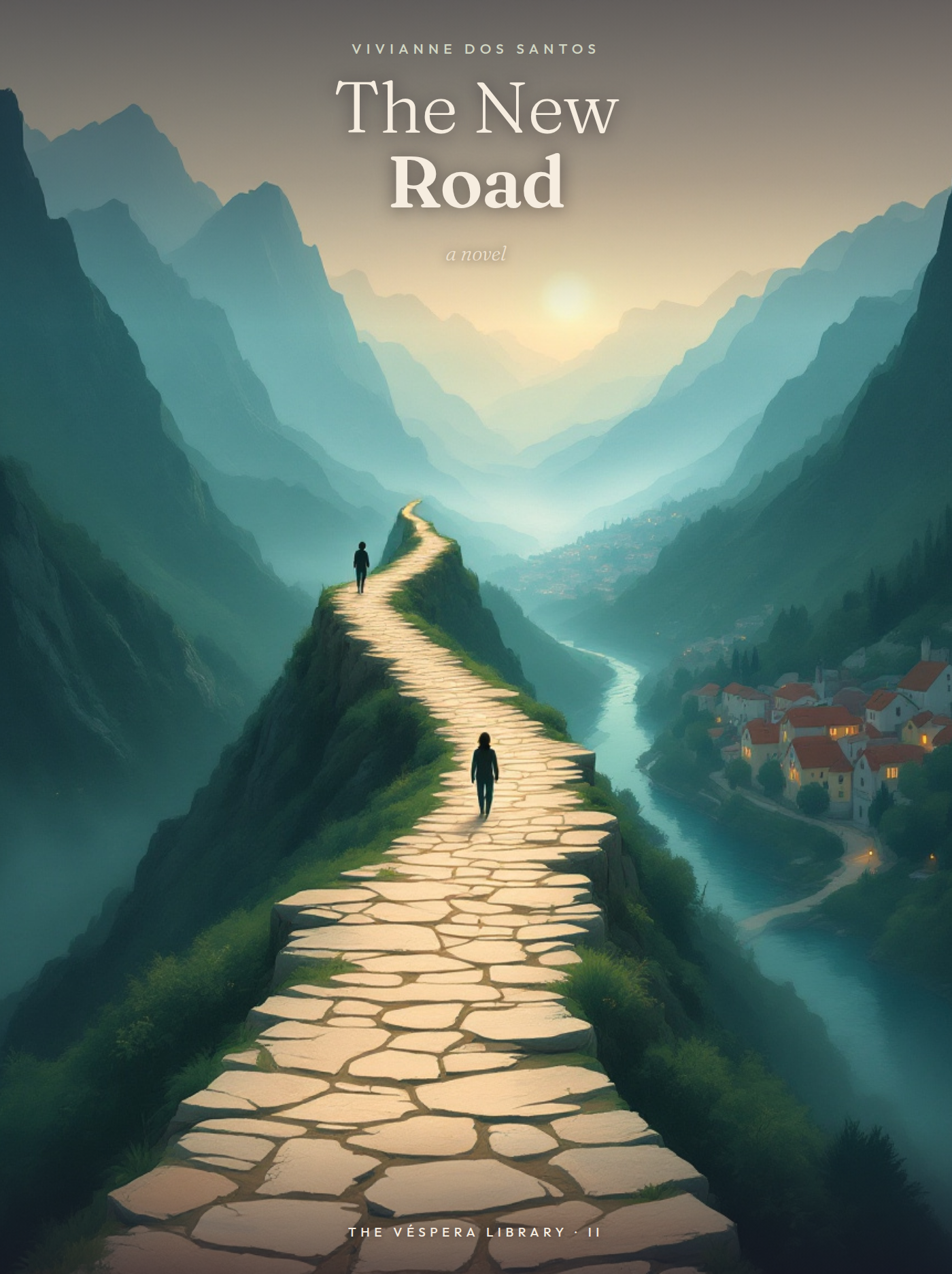
The New Road
Aurora was first at everything and never felt she had arrived: each victory becomes the step to the next, and the finish line keeps receding. She spent a life chasing an arrival that does not exist at the top of the climb — because the goal was never hers, it was her father’s, the “and now?” he never let fall silent. It is the story of a woman who confused climbing with arriving, and who only learns, on reaching the highest summit and finding it empty, that arrival is not a place reached by climbing: it is a decision to stop and to be where you are. The words at the end, on a morning with nothing special about it: I have arrived. I am here. And here is enough.
A novel · 12 chapters, complete. Read the first one below; the whole book is in the shop.
From the register of Véspera
In the register of the village, by the hand of the Keepers who passed through the book, is found:
Aurora, daughter of Firmino and of Véspera folk. She was the first at everything: the best of the village school, the first of her house to rise, the first woman of Véspera to reach places no woman had reached. She rose her whole life, without stopping, and was the pride of the house and of the village.
The name was a promise: her mother wanted her the name of the dawn, of the breaking of the day, dreaming of a daughter who would rise and go far. And life gave a woman who was always in the dawn of a new goal and never in the noon of having arrived, because each victory, the moment she reached it, became the step of the next, and the arrival always drew back, one more step, one more new road.
The register says who was born, who married whom, who departed. It does not say what it costs one who runs a whole life after an arrival that always draws back, nor where one stops, if one stops at all, who has climbed every stair and never felt they arrived. For that, books such as this one are needed.
chapter one
The first at everything
On the day the village of Véspera put Aurora's name on a plaque, at the foot of the Fountain Square, Aurora felt, in the midst of all those people clapping their hands, colder than she had felt in her whole life.
It was a September afternoon, and the whole village was there. They had given her a plaque, a thing of stone with her name on it and some words written in letters of gold, the first woman of Véspera to, and the rest Aurora no longer read, because there was always an a that opened a sentence meant to make her great and that she heard as one more step. The president of the parish council, Lucas Ramalho, gave a speech with the paper in his hand, trembling a little, and said, pointing her out with his chin: here is the proof that from Véspera too come people who go far. Aurora arrived. Aurora is the one who arrived.
And it was that arrived, said aloud in the middle of the Square, with the whole village applauding, that entered Aurora like a splinter of ice, because it was exactly what she did not feel. She stood beside the plaque with her name in letters of gold, and within there was no arrival at all, there was a tired woman already thinking of the next morning's train and of the thing she had to see to on getting there, of the step after that step, and who received the village's arrived the way one receives a word in a language one does not speak. She smiled. She thanked them. She shook the hands held out to her. And the cold stayed.
Whoever saw her thus, from outside, envied her her life, and no one imagined that the most successful woman in Véspera was, within, one of the most tired and most empty, because she had spent her life running to an arrival that never came. There are people who run for the love of running, of the climbing, of the conquest; and there are people who run because they are afraid to stop, because to stop brings them an anguish that only the movement smothers. Aurora, though from outside she seemed of the first, was of the second. The running was, for her, less a pleasure than a flight. It was her coat against the cold of an emptiness that awaited her whenever she slowed, and she never took it off, even exhausted, because to take it off was to feel the cold. That afternoon in the Square, stopped beside the plaque, was the first time the cold entered her even with the coat on, and Aurora did not yet know what that meant, but she did not forget it.
On her way out, making a path through the people, she heard what is said behind the back of one who carries off a plaque. Two women, by the fountain, Idalina of the vegetable gardens and another, spoke of her as she passed, without malice, with that respect that has a little of envy within it. There goes Aurora, said Idalina, low, but not so low that Aurora did not hear. That one went far. That one arrived. And the other, almost crossing herself: arrived, arrived. Would that I had half of it.
And Aurora went on, with the plaque they had given her to take home tucked under her arm, cold as the stone it was, and thought, without saying it to anyone, that she would give the whole plaque, and the name in letters of gold, and Lucas Ramalho's speech, for a single chance to feel what those women thought she felt. Arrived, arrived. It was the word that wounded her most, and no one knew, because it was exactly what she did not have, and to hear others say it was of an irony that hurt her like a tooth.
Since she was a girl she had been the first. The best of the village school, the one the teacher Anacleto pointed to as an example, the one who got the best marks with no apparent effort and who, when effort was needed, made it better than everyone. And she did not stop at the school: she was the first of her house, humble folk, to rise in life, the first to leave the poverty she came from, the first woman of Véspera to reach places no woman had reached. She rose, Aurora, her whole life, step by step, and each step was higher than the previous, and the village looked at her from below, with pride and with envy, oh Aurora, that one triumphed.
But the village's admiration was, at bottom, a way of not knowing her. They admired the runner, the winner, the figure of the plaque, and not the person within, whom no one saw because she did not show her and perhaps not even she herself knew her. There is a particular solitude in this, in being admired for a figure one is not within, in receiving the love of what one has done and never that of what one is. The admiration for what one has done does not warm like the love for what one is; the admiration is out there, on the pedestal, and the person, on the pedestal, is alone. And Aurora, atop her pedestal, was one of the loneliest women in Véspera, because everyone admired her and almost no one knew her.
She had triumphed, it was true. By the world's account, it was a success, a life well lived, an example. She had a name, she had position, she had everything the village considered to be arriving in life. But there is an account the world does not make, the account of within, that of what a person feels, and by that account Aurora had arrived nowhere, because never, not once, in her whole life of victories, had she felt herself arrived. Each victory, in the instant she reached it, ceased to count, emptied itself, because her head was already on the next step. She won a thing and did not savour it. She reached a summit and did not enjoy it, because she already saw, from there, the next summit, higher, to be conquered. And so Aurora lived, atop a life of successes, in a hunger that no victory killed, because the hunger was not of victories, it was of a thing the victories promised and never gave: the sensation of having arrived, of being enough, of being able to stop.
The plaque of that afternoon ended up in a storeroom, leaned against the wall, its face turned inward, and Aurora never hung it. She did not know how to explain to herself why, but she did not want it in sight. Years later she would understand: to hang the plaque was to have to see it every day saying arrived to her, and she could not bear the word on the wall, as she had not borne it in Lucas Ramalho's mouth, because the word lied, and she knew it lied, and a lie nailed to the wall of one's own house is a thing no one can stand from morning to night.
The treadmill never stopped. That was how Aurora, later, would describe her life: a treadmill that was always moving, and she running on it without ever arriving anywhere, because the treadmill always brought her more ground beneath her feet, one more goal, one more step, and however fast she ran she never reached the end, because the treadmill had no end. She ran, Aurora, exhausted from running, and did not stop, because to stop, in her head, was to fail, was to fall behind, was to cease being the first, and to be the first was all she knew how to be.
There was a word Aurora never used, and it was the word enough, because for her nothing was ever enough, never, and the word did not fit in her vocabulary. The others said it is good, that is enough, no more; Aurora not, Aurora said it could be better, more is needed, not yet. Enough was, for her, a word of the weak, of people without ambition, of people who content themselves; and she did not content herself, never, on principle, because to content oneself was to stop, and to stop was to fail. And a world without enough is a world without rest, because rest comes from feeling that one has enough, and one who never feels they have enough never rests. Only much later would Aurora learn to say enough, and to feel it, and would discover that it was the most freeing word of the language, the one her whole life had lacked, the one that, said and felt, was the arrival itself.
And in running, she went on letting fall along the way everything that was not the running. She let fall the friendships, which had no time to grow because she was always departing; she let fall the love, which withered beside a woman who was always elsewhere in her head; she let fall the rest, the enjoyment, the small joys, because all of that were stops, and she did not stop. She came to the height of her life of successes with her hands full of victories and her life empty of all the rest, alone, exhausted, surrounded by plaques and by no one, because she had traded everything that was not the running for the running, and the running, in the end, had not given her what it promised, had not given her the arrival, had only given her more running.
It must be said, so that Aurora be understood and her life not only envied, what it is to live so within, because from outside it seems enviable and within it is a prison. To live so is never to rest, because rest is a stop and the stop is forbidden; it is never to celebrate, because celebration is a stop; it is to have always, beneath any joy, the shadow of what is lacking, the step to climb, and that shadow robs all the joy, because there is no joy that survives the shadow of what is still lacking when what is lacking is infinite. Aurora, the most successful woman in Véspera, was, within, one of the unhappiest, caught in a prison she herself had built and that had the shape of a stairway with no top.
She was, when this story begins, a good fifty-some, perhaps sixty, a woman still at the height of her capacity, still rising, still winning; but it was a tired height. Because her whole life, when she grew tired, Aurora ran more, and the running smothered the tiredness, gave her a new aim, a new adrenaline, and the tiredness passed to the second plane. And she had come, that afternoon of the plaque and those that followed it, to a point where the running no longer smothered the tiredness, where to run more no longer gave any adrenaline, only more tiredness; and Aurora found herself, for the first time, without her usual tool, because the tool with which she had always fought the tiredness, to run more, no longer worked, it only worsened it. There is a point, in the life of one who runs, when the running ceases to save from the tiredness and becomes the cause of it, and Aurora had come to that point.
And she began to look back, at the road of victories that was her life, and to ask herself, with a tightening, where all that had taken her; and the answer, when she dared to see it, was frightening: nowhere, because she had never stopped anywhere, never arrived, had always passed through everything running to the next. And it was that question, where has all this taken me, that began, slowly, to open in Aurora a chink through which there would enter, at last, the light that would show her what no one had told her: that the arrival she pursued her whole life was not at the top of any stair, and that she could run forever and never reach it, because the arrival was not a place, it was a thing she would have to learn to do, and that was called, simply, to stop.
· end of the sample ·