The Véspera Library · novel thirteen
The Full Pantry
Fartura was born in a year of hunger and inherited its fear without ever having it at her table. She has the fullest pantry in the village and the poorest table: she keeps the best until it rots, and always eats the worst. This is the year she learns, late, that abundance is not for having, it is for living.
A novel · 12 chapters, complete. Read the first one below; the whole book is in the shop.
From the register of Véspera
In the register of the village, by the hand of the Keepers who passed through the book, is found:
Fartura — plenty — daughter of people of the village, born in the second of the years of hunger, when the mountain gave nothing and the river brought nothing and in Véspera the mouths were counted as coins are counted, slowly and with fear.
The name was a promise, one of the most anxious the village ever set down: the mother, still carrying her, with the house living on roots and on faith, wanted the daughter to bring in her name the thing that was missing from the table, and called her Plenty, so that the word might do what the earth would not, and the girl might have, at least at her christening, what the house did not have in its chest.
The register says who was born, in which house, with which name. It does not say why there are those who come into plenty and never taste it, nor what chest that is which is filled a whole life and never opened, nor what a person keeps in the pantry when what she keeps there is fear. For that, books such as this one are needed.
chapter one
The best for later
Fartura's pantry was the best stocked in Véspera, and no one in the village ate worse than she did.
The two things were true at the same time, and at the same time Fartura carried them, seeing in them no contradiction, because for her there was no contradiction: the pantry was to be full, and the table was to be put up with, and anyone who confused the one with the other simply had not been through what it took to learn the difference. The pantry filled for the case of. The table was laid with what would no longer keep. And between the case of and what would no longer keep lay a whole life of Fartura, near sixty years, choosing every day, at every meal, the worst of what she had, because the best was for later.
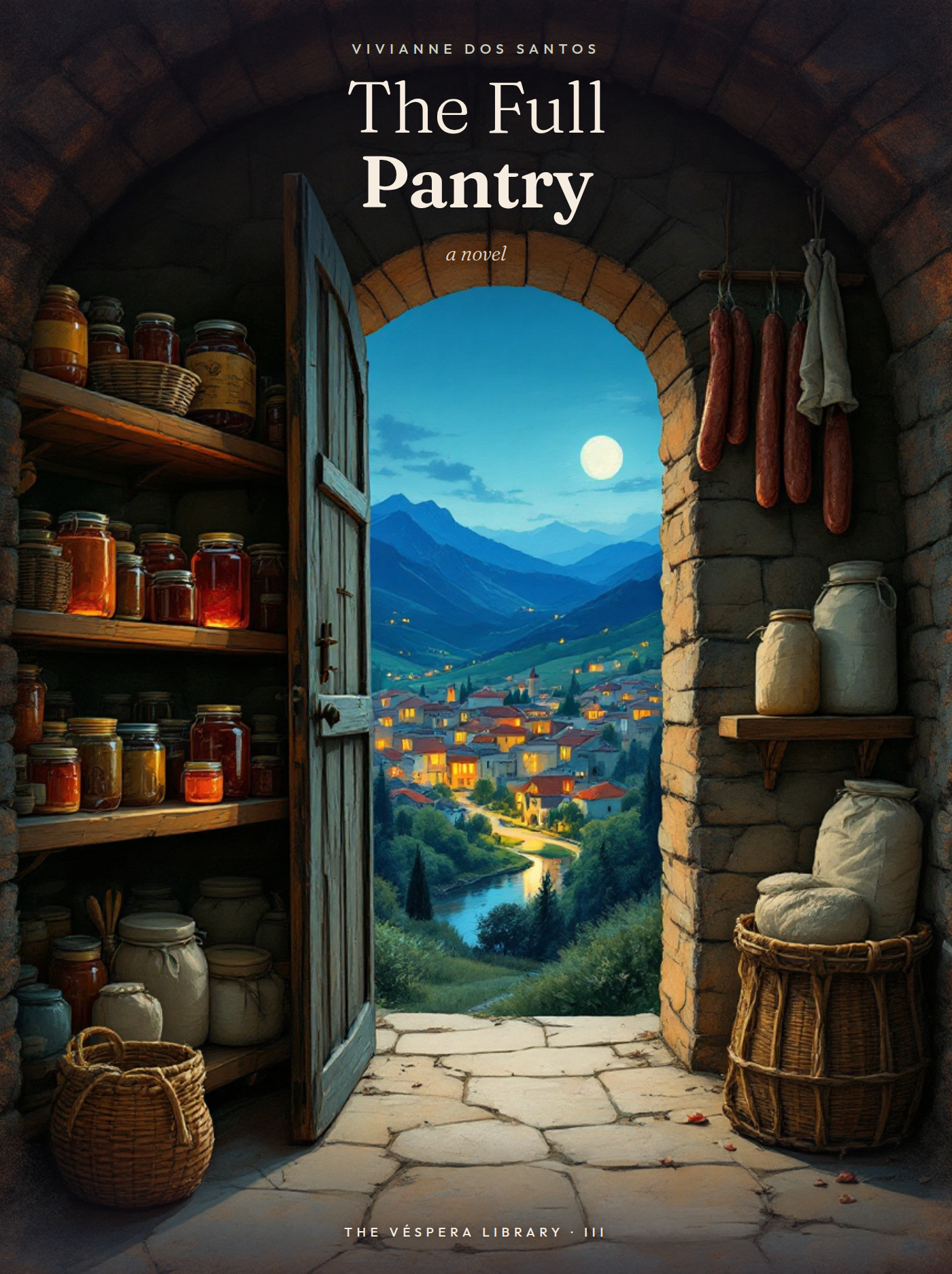
She had it at the back of the house, the pantry, a cool room of thick walls that her father-in-law had built for the wine and that she had taken for herself the way one takes a throne. Inside, on the shelves that Bento had nailed up for her year after year as she asked for more, was kept what in Véspera was called having one's back warm: the jars of jam lined up by year, with the year written on the lid in her hand, round and sure; the cured meats hung from the rods, curing and going past the point of curing; the oil in the bottles, the honey in the pots, the flour in the cloth sacks, the beans and the chickpeas in earthenware crocks with their mouths tied, the dark marmalades grown old, the boxes of biscuits bought at the feasts and never opened, the sugar, the salt, the preserves she made herself in summer, sweating over the fire to fill shelves that no longer had room. It was a pantry to spare, to the letter, a pantry that gave its name to its mistress, and anyone who came in from outside would say that people of means lived there, people who ate well and slept easy.
There was in it an order that was Fartura's alone and that no one else understood, not even Bento, who respected it without grasping it. Things had their place by age and by worth, and the two measures crossed in a way that gave the reverse of what they would have given another mistress: the best and the oldest went to the back, to the depths, up high, where the hand reaches with difficulty and the eye does not fall, because the best and the oldest were what most had to be protected from use; and the worst and the most recent stayed at the front, to hand, in the light, because those were the ones to be eaten, to be spent, of least loss. Whoever opened Fartura's pantry saw the worst first, and took it for a modest pantry, and that was the deception that Fartura, without thinking it, set up: the true plenty was hidden behind a front of things going off, like a miser who shows the hole in his pocket and sews the gold into the lining.
And at the table, in front of that pantry, Bento ate bread with sausage from what was already drying out, and Fartura scraped the bottom of the previous day's pot, and what was fresh and good and tender stayed on the shelf keeping her fear company, fattening the plenty of the pantry and wasting away until it went to the pigs, because Fartura's plenty was not for eating: it was for having. It was a sum she did in her head, lying down, before sleep, the way others pray: so many jars, so many sausages, so many sacks, and the sum gave her sleep, gave her the only peace she knew, the peace of one who knows herself covered for the winter that is to come, because Fartura, at the bottom of everything, on every day of her life, was waiting for a winter that is to come.
That was the secret of the pantry, and Fartura would not have said it for anything in this world, because not even to herself did she say it in words: the pantry was not full of food, it was full of fear. Each jar was one day less of dread. Each rod of sausage was a promise that, if the mountain did not give and the river did not bring, if the year came back in which the mouths are counted, Fartura's house had the means. And as long as the pantry was full, the winter could come, for she was covered; and so the pantry could never be less than full, and so what came in stayed, and what stayed was kept, and keeping was the religion of the house, and to eat the best was a sin that Fartura never committed.
That morning she went down to the village, as she did on Wednesdays, with the basket on her arm, and the village already knew her: Fartura, who bought as one provisions oneself for a siege. She came down the cobbled street slowly, stopped to give her good-mornings with the right measure, neither too much nor too little, and went to the Shop, which was the centre of her world as it was the centre of half the village's. At the Shop, Benvinda set the best before her, the first broad beans of the season, tender, of a green that was almost a smell, and the cheese at its point, buttery, and Fartura looked at the best with her mouth watering and her stomach in a knot, both at once, as always, and asked for the other, for what was going off, for what Benvinda would have to mark down before it was lost. I'll take this, she said, the one turning, for what I need it for I don't need the fine. And she took what was turning, the beans already a little past, the cheese from the corner, and paid for it on tick, in Benvinda's ledger, not because she was short in her purse, which she was not, but because to pay on the nail was to break up the little heap, was to see the money leave her hand, and Fartura would rather owe a little to everyone than see herself empty-handed even once. Put it down, she said, it'll be squared at month's end. And at month's end she squared it, to the last coin, for to truly be in debt frightened her too; but in that gap between buying and paying, in that little while when the money was still in the purse and the food was already in the basket, Fartura had both things, and to have both things was the only kind of plenty that tasted good to her.
Benvinda, who saw everything from her side of the counter and who had her own knot with giving and receiving, marked it in the ledger without a word, because she had said it once, years before, and Fartura had not heard. Once, only once, Benvinda had said to her, with the gentleness of one who notices: oh Fartura, you've the means to pay outright, I know you have, what are you doing owing me crumbs for? And Fartura had been so distressed by the question, so exposed, as if Benvinda had opened her pantry in front of the whole village, that Benvinda never asked again. Each of us has our knot, Benvinda thought, mine which is not knowing how to charge, hers which is not knowing how to spend; and she marked Fartura's tick in the ledger where she marked half the village's, and watched her go up the cobbles with her basket of things going off, and had for her, without saying it, a kind of pity between equals, the pity of one who recognises in another a tightness of the same family as her own.
On the way out of the Shop, in the square, the fountain was dry as always, and Fartura passed it without looking, for the dry fountain was to her a sure thing, almost a thing of the family: a fountain with water was a fountain that could be spent, run dry, fail; a dry fountain, no, a dry fountain was at the bottom of her fear, was in the place where Fartura put the things that confirmed what she knew, which was that abundance was not to be trusted, that water goes, that the mountain does not always give, that what seemed full could be left empty in a season. She crossed the square at the pace of one who carries weight, though the basket was light, because Fartura always carried weight, even empty-handed, and there were those who said, seeing her pass, that Fartura walked stooped like one carrying the pantry on her back, and they did not know how right they were.
The granddaughter was waiting at home. Alegria — joy — was seven, with the name her mother had given her against the custom of the family, which was of more anxious names, and she was a child who bore the name out: she laughed at nothing, ate with relish, opened all the doors of the house just to see what was inside, and treated the world as a thing that was there to be tasted, smelled, handled, without mistrusting it, because no one had yet taught her to mistrust. She stayed with her grandmother on Wednesdays, while Clara worked, and she was the only person in Véspera to whom Fartura's pantry held no awe at all, because Alegria saw in it neither a treasure nor a siege: she saw food, and food, to Alegria, was for eating.
Grandma, she asked that morning, standing at the door of the pantry that her grandmother had left ajar, her eyes running over all the shelves, the jams, the sausages, the unopened biscuits, the pots with the year on the lid, Grandma, who is all this for?
And Fartura, who was putting away what she had brought from the Shop, stopped with the sack of flour halfway through the gesture, and did not know how to answer.
It was a child's question, of the kind children ask without knowing what they carry, and Alegria had already moved on, was already at something else, had already forgotten she had asked, with that lightness of children who drop the great questions the way they drop a toy, without noticing the weight of what they dropped; but Fartura was left with the question in her hand as she had been left with the sack of flour, not setting it down and not knowing where to put it. Who was all that for. She did the sum, as she did at night, but the sum, by the light of day and by the light of the question, gave her something other than sleep: it gave her a tightening. Because the truth, the truth she never let herself say, was that it was not for anyone. It was not for her, who did not eat it. It was not for Bento, who ate what was left over. It was not for Clara, who had her own house and her own way. It was for the winter. It was for the case of. It was for a disaster she had been waiting for sixty years and that did not come, and Fartura, with the sack of flour in her hand, in the middle of the full pantry, had for an instant the sense of keeping food for a dead man, or for a ghost, or for a hunger that had already passed and lived only in her.
She closed the pantry door, as one closes a matter, and went back to the kitchen, and put on the fire the worst there was for lunch, as always, some reheated scraps on the edge of no longer being good, and said to herself that Alegria's question was a child's question, and that children do not know what it is to go hungry, thank God, and that it was for that very thing, so that Alegria would never know it, that the pantry was full. But the answer, said like that, did not settle her as it used to settle her, because there was in it a hole that Fartura did not see but felt: if the pantry was full so that Alegria would never go hungry, then why did Alegria eat, at her grandmother's house, the worst, while the best rotted behind a closed door? What use was it to cover the granddaughter against a hunger that was no longer there, at the cost of leaving her hungry for what was right there, a hand's breadth away, kept? What kind of protection was that, which denied in the present, every day, what it claimed to be keeping for a future that never came?
The question had no answer, and Fartura knew it had none, and so she did with it what she did with the questions that had no answer, which was to put it on the top shelf, at the back, behind the jars, with the other things one keeps for later. They ate the worst. Bento ate in silence, as he had eaten for forty years, and at a certain point he looked at her over the plate, in that way he had of looking at her when he wanted to say a thing and left it unsaid, and said nothing, and went back to the plate, and Fartura, who knew that look, made as if she had not seen it. The afternoon passed. Clara came to fetch her daughter at the end of the day, and Alegria went out telling her mother the things she had seen in her grandmother's pantry as one tells of a discovered country, and Fartura stood at the door watching them go down the street, the granddaughter hopping from stone to stone on the cobbles, the daughter holding her by the hand, and the dry fountain down there, in the square, in its usual place, giving water to no one and being, even so, true, true to the nature that Fartura had always recognised in it, the nature of a thing so spared that it had stopped serving what it was made for.
That night, lying down, Fartura did the sum of the pantry as she did every night, to call sleep. So many jars, so many sausages, so many sacks. But the sum did not come clean as it came. It came with Alegria's voice over the top of it, who is all this for, Grandma, and Fartura, who for sixty years had fallen asleep counting what she had, fell asleep, for the first time, asking herself what she had it for, and it was a bad sleep, the sleep of one who left the pantry ill-closed, with a chink of light coming in where all had always been dark. And in the chink, in the thread of light that came in, she saw herself, far off, small, a woman with her hand closed in front of a full pantry, keeping the best for a later that was already, that night, more past than future, and she had for her, for the small woman in the chink, the first pity she had had for herself in sixty years, and pity, unlike fear, did not let her sleep easy, but left her, for the first time, truly awake.
· end of the sample ·