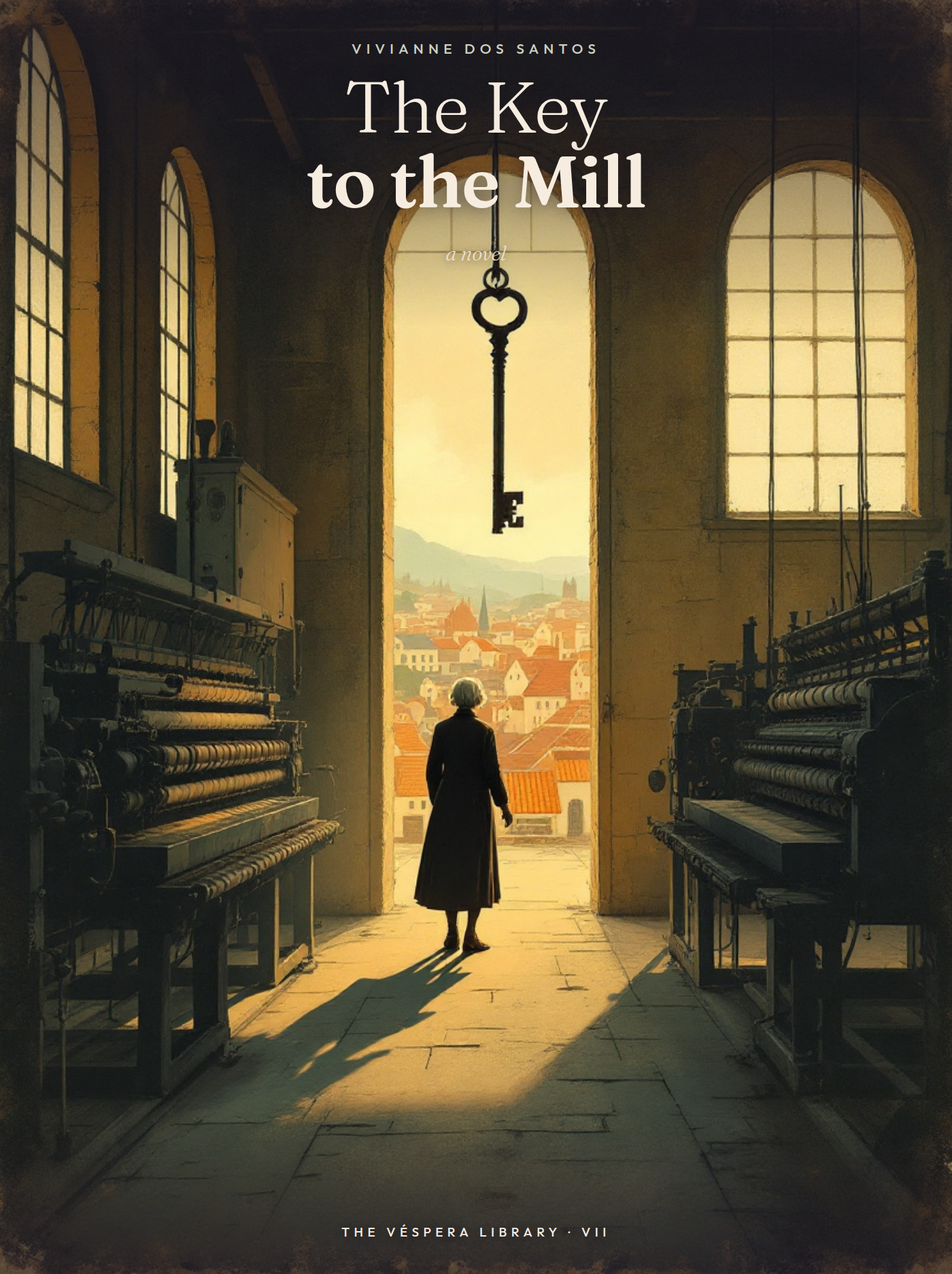
The Véspera Library · novel twenty-one
The Key to the Mill
For thirty years the key to the Spinning Mill has been Preciosa’s: she opens before all, closes after all, knows where everything is and how everything is done. She never took a whole holiday; to fall ill, for her, is to organise the illness so as not to be absent. If I stop, everything falls, is the phrase that sustains her and fences her in. This is the year she hands over the key, for a week, and watches, with terror and then with astonishment, the mill working without her, and discovers what the phrase hid: it was not the mill that fell without her, it was she who did not know who she was without the mill.
A novel · 12 chapters, complete. Read the first one below; the whole book is in the shop.
From the register of Véspera
In the register of the village, by the hand of the Keepers who passed through the book, is found:
Preciosa — precious, the one of worth — daughter of the village, and the name was prophecy and trap: they called her Preciosa, the one who is worth much, the one of price, and she fulfilled the name by making herself indispensable, the one who cannot be done without, the one without whom nothing moves; but the name, which seemed a blessing, was a trap, because whoever makes herself indispensable becomes bound to the very thing that makes her indispensable, and Preciosa made herself the key of a mill.
The register keeps who holds the houses and the trades of the village, and to what thing each name fastened itself. It does not say who a person is without what she does, nor what is discovered, on the far side of the fear, on the day one hands over the key and sees the mill go on without us. For that, books such as this one are needed.
chapter one
The key
Preciosa had the key of the Spinning Mill, and the key was more than a key: it was she. For thirty years it had been Preciosa who was first to arrive, in the morning, to open the gate, to start up the machines, and last to leave, at night, to switch everything off, to lock up; and in those thirty years the key of the mill had fastened itself to her hand in such a way that one no longer knew where Preciosa ended and where the Spinning Mill began.
It was a large key, of dark iron, with a long shaft and a head shaped like a rough heart, of the kind no longer made, and it had a weight in the hand that new keys do not have. Preciosa carried it on a ring of its own, apart from the others, threaded on a length of cord that she changed herself whenever it began to fray, and in the morning, in the dark, she knew it among all the rest by touch alone, by the coldness of the shaft and the wear of the head, with no need of light. The gate of the Spinning Mill had two leaves, with a padlock on the outside and a lock on the inside, and there was a trick to opening it that only Preciosa knew: half a turn, draw the leaf towards you with the knee, and only then turn it the rest of the way, because the gate had settled with the years and would bite the key if you forced it in haste. Anyone who did not know the trick was left in the rain, cursing, with the key jammed, and that, deep down, was what had made her content for thirty years: that there was a trick, and that she was the one who knew it.
It was a quarter to six when she arrived, always, in cold or in heat, on a Monday or on the eve of a holiday. The village still slept, the serra was a shape lying down, and Preciosa came down the mill street alone, with the sound of her own footsteps for company, and the first thing she saw, as she turned the corner, was the chimney of the Spinning Mill against a sky that was barely lightening, cold, waiting. She opened the gate with her trick, and the sound of the key biting and then yielding was the first sound of the day, and it was a sound that belonged to her. Then she went into the dark of the shed, which smelt of machine oil and cotton thread and the damp of stone, and went to start the machines in the right order, one by one, and the mill woke around her the way a body wakes, first the heart, then the limbs, and Preciosa, in the middle of that waking, felt herself the one person in the world the world had need of.
There was, on the jamb of the gate, a small groove, worn into the iron, at the height of her hand. It was Preciosa who had made it, without meaning to, over the years, always resting her hand in the same place to draw the leaf with her knee, and the iron had given way to the wearing of the hand, slowly, the way stone gives way to the drip, and there had formed a smooth gleam, a mark, the mark of her hand repeated thirty years. Preciosa knew that groove by heart, and sometimes, on opening, she would run her thumb across it, without thinking, like someone greeting a thing of her own; and it was, that groove on the jamb, the deepest proof that she and the mill were one, because even the iron of the gate held the shape of her hand, engraved at the cost of dawns, and there was no other hand in the world that fitted exactly into that groove.
When the others arrived, at eight, everything was already running. They found the lights lit, the machines warm, the shed ready, and never, in thirty years, had they found the door shut at their hour, not once, because Preciosa always came first, and that was one of the things the whole mill knew without saying: that the Spinning Mill opened because Preciosa opened it, and that if one day the door were shut at eight, it would be because something very great had happened, a calamity, and no one in the mill knew quite what, because it had never happened.
It was Preciosa who knew where everything was, in the mill. She knew on which shelf each part sat, and she knew it by heart, without a catalogue, because the catalogue was she. Idalina, the oldest weaver after her, with hands already of wax and her eyes failing but her ear tuned to each loom like a mother to her child's crying, would say often, when a machine began to make a sound it should not, fetch Preciosa, Preciosa will know. And Preciosa would come, lay her ear to the machine, put her hand on the gear, and say it's the third pinion, it's asking for oil, or it's the belt, in three days it'll snap, I'll change it now, and it was always the third pinion, it was always the belt, and Idalina would shake her head with a respect that was almost devotion and say this woman has the machines in her head.
Belmiro, who saw to the maintenance, was a willing and obliging man, but the truth is that twenty years in the mill had not been enough for him to learn what Preciosa knew, and the fault was not all his. When the big thing broke down, the serious thing, the boiler or the central motor, Belmiro would fetch Preciosa, and Preciosa would not say to him do it like this, I'll show you; she would say get out of there, let me see, and she would do it herself, quickly, with her own hands, and Belmiro would stand behind, watching, and he watched badly, because one who only watches never learns, and at length he would give up watching and go and do something else, and the breakdown would be mended and the knowledge would stay with Preciosa, intact, as she wanted it without wanting it.
Otília, of the accounts, of the small office with the window onto the yard, knew the numbers, but to know what the numbers meant she would go to Preciosa: which client pays at thirty days and which is always late but pays, which supplier delivers on Thursday and which promises and fails, how much thread is needed for the order of sheets and how much margin is left over for the unforeseen; and Otília wrote in her books what Preciosa dictated from memory, and the books seemed to say that it was Otília who saw to the accounts, but Otília knew, and said so at home, that the mill went in Preciosa's head and that the books were only her shadow on paper.
And there was the notebook. There was a black-covered notebook, worn at the corners, with an elastic band that no longer stretched, where Preciosa noted down the orders, the deadlines, the ways of the clients, and that notebook went in the pocket of her smock and slept in her house, and no one else laid a hand on it. When a client telephoned to ask after an order, it was Preciosa who took the notebook from her pocket, leafed through it with a finger wet with spit, and said your cloth will be ready Thursday, I'll send it round in the morning, and hung up, and the client was easy because Preciosa's word was good, and Otília, in the office, did not know where what Preciosa had just said was written, because it was in the notebook, and the notebook was in the pocket, and the pocket went home.
There was one day, in particular, that showed well how it all went, and that was a day like a thousand. It was a Tuesday morning, and there were three things at once, as always: the central motor making a new noise, a supplier's lorry at the door unloading the wrong thing, and the telephone ringing with a difficult client. And Preciosa, as always, did the three. She said to Belmiro hold the motor there, I'm coming, and shouted to the lorryman that's not what we ordered, take it back, and answered the telephone with the other hand, all at once, on a loom of things that only her head could spin. Zé Maria, a lad from the bales, still new to the place, stood watching her do it and said, with admiration, but how do you manage everything, Preciosa? And Preciosa answered, without stopping, with a pride that came out ahead of her thinking: I manage, son, because if I didn't, this would stop. And Zé Maria shook his head, and Preciosa felt herself, in that instant, at the centre of the world, with the whole world needing her at once, and she was happy, in her own way, which was the only manner of happiness she knew.
But there was, that same day, a small thing that told the rest, and that Preciosa did not even notice herself doing. At the end of the afternoon, when things were calmer, Zé Maria, full of good will, came to her and offered: Preciosa, teach me to deal with the suppliers, and next time I'll see to the lorry and you'll be free for the motor. It was a good idea, a clean idea, and Preciosa looked at the lad, and instead of saying good idea, come here and I'll teach you, she said what she always said, with a smile that softened the refusal: leave it, son, this business of the suppliers has its tricks, better it be me, I do it quicker. And Zé Maria shrugged and went off, and the thing stayed, once again, with Preciosa; and it was so, day after day, offer after offer refused with a smile, that the whole mill went on hanging itself upon her, and that she went on gaining, each time, one more chain that she mistook for one more medal.
And so, year after year, the mill had been built around Preciosa, dependent on her for everything, and Preciosa had been becoming the key without which the Spinning Mill did not open, did not run, did not close. And in that Preciosa had her pride, the greatest of her life. To be indispensable was what she was, was what gave her the place, the importance, the meaning; to arrive in the morning and be the first, to have the key, to open the mill, to set everything going, to be sought the day long to settle this and that, to be the one without whom nothing got done, was the thing that filled her, that made her feel she was someone, that justified her life; and each time Idalina said fetch Preciosa, or Belmiro handed her the breakdown with a let me see, or Otília came to ask her about a client, Preciosa felt a deep satisfaction, that of being indispensable, of being worth something, of not being able to be done without.
But there was, beneath that pride, a thing Preciosa did not see and that was going to be the book: that she had not become the key only because she was good. She had become the key on purpose, without knowing it, by making everything pass through her. She did not teach Belmiro because it was quicker to do it herself; she did not dictate all the accounts to Otília because the notebook was hers; she let no one open the mill in the morning because the trick of the gate was hers and she trusted no one else with it. She kept the knowledge, the keys, the tricks, in such a way that no one in the mill could do what she did, and that she might be, for that reason, irreplaceable; and that irreplaceability, which she lived as merit, was in part a construction, a wall she had raised around herself, stone by stone, day by day, so that no one could do without her, so that they would always need her, because to be needed was, for Preciosa, the only way of feeling safe.
And there was, in Preciosa's life, a solitude she had never called by its name, because the mill covered it, as the mill covered everything. She lived alone, in a house she had inherited from her parents, and the house was always tidy and cold, because she did little more than sleep there; and on Sundays, the one day the mill closed, Preciosa did not know what to do with herself, and would find herself, many times, going down to the shut mill only to check a thing that needed no checking, only to be where she knew how to be. She would open the deserted gate, with her trick, on a Sunday, and stand in the silent shed, alone, running her hand over the stopped machines, and it was there, in the midst of the hushed machines of a Sunday, that Preciosa felt herself, strange as it may seem, less alone than at home; because in the mill she was the key, and at home she was no one. And she had never thought of this as a sadness, she had always thought of it as devotion, and it would take an ache in the chest, and a Keeper, and a forthright girl, for Preciosa to begin to suspect that going down to the mill on a Sunday so as not to be alone was not love of work, it was flight from herself.
And the price of that wall was enormous, and Preciosa paid it without complaint. She never took whole holidays, because if she were absent a week the mill would not run, or she believed it would not; when she fell ill, she arranged the illness so as not to be absent, went to work ill, took work home; she had no life outside the mill, no time, almost no relations, because the mill took up everything, and she let it take it up, because without the mill she would not know what to do with herself. And the years went by, and Preciosa, at fifty-four, had given her whole life to the Spinning Mill, and had nothing else, no husband, no children, no life of her own, only the mill, only the key, only the being indispensable, which was all that she was.
And the body, at fifty-four, was beginning to warn her. The weariness of thirty years without whole holidays weighed on her; the aches, the strain, the exhaustion of being always the first and the last, of carrying the whole mill on her back, were beginning to exact their due. And there was a morning, at the start of the book, when the body spoke to her in earnest. She had just started the central motor, still in the dark of the shed, alone, and on straightening up she felt her chest tighten like a fist, a tightening that rose into her arm and her jaw, and the shed went round about her, and Preciosa had to take hold of the cold edge of Idalina's loom so as not to go to the floor. She stayed there, doubled over, breathing as she could, with the key still in her hand, sweating a cold sweat, and for an instant, one instant only, she could not. She could not start the rest of the machines, could not throw the gate wide, could not be the key. She had to sit on the crate of scraps, by the loom, and wait for the fist to let go of her chest.
And it was in that instant of not being able, alone in the dark, with the mill still unlit around her and the key weighing in her hand as it had never weighed, that Preciosa had a thought that frightened her more than the tightening in the chest. It was not I am going to die. It was: if I fall, for good, this morning, here, what becomes of the mill? Who opens it? Who knows the trick of the gate, the third pinion, the notebook? And straight after, before she could check it, came the other thought, the one the book was keeping for her, and it was worse, far worse, because it did not frighten her for the mill, it frightened her for herself: and what if the mill opens just the same? What if someone hits on the trick, and starts the machines, and the mill runs without me, this morning, with me not there? What becomes of me?
It was not the first time the body had spoken to her, but it was the first time she had had to listen. Months before, the new doctor at the centre, taking her blood pressure during one of those check-ups the mill required, had shaken her head and said, you're going about with this very high, Preciosa, you need to rest, to take a few days; and Preciosa had laughed and said the phrase, ah doctor, if I stop everything falls, and the doctor, who was from away and did not know the phrase, had looked at her over her glasses and asked, in earnest: and do you think the mill standing is worth more, or you alive? And Preciosa had not known how to answer, then, and had put the question away, as she put away everything that did not fit the day. Now, sitting on the crate of scraps with the fist letting go of her chest, the doctor's question came back to her, the mill standing or you alive, and for the first time Preciosa saw that she had been living the two as though they were the same thing, and that perhaps they were not, and that perhaps the day would come when she would have to choose.
The tightening let go of her chest little by little. Preciosa rose from the crate, slowly, with her legs still weak, and stood in the dark, her hand closed around the key, and she did not at once start the rest of the machines. She stayed there a while, still, listening to the silence of the unlit mill, and she understood, with a shiver that was not from the cold of the morning, that the phrase she had said for thirty years, if I stop everything falls, was perhaps not what she had always thought it was. Perhaps it was not only about the mill. Perhaps it was, above all, about her, about the fear of discovering that the mill ran without her, and that she, without the mill, without the key in her hand, without the trick, without the notebook, without anyone calling her, did not know, for certain, who she was.
Then she started the machines, one by one, in the right order, and threw the gate wide, and when the others arrived at eight everything was running, as always, and no one noticed a thing. But Preciosa had noticed. And in Véspera it is known, better than anywhere, that there are questions which, once asked in the dark of a morning, never fall asleep again.
· end of the sample ·