The Véspera Library · novel fifteen
The Unfinished House
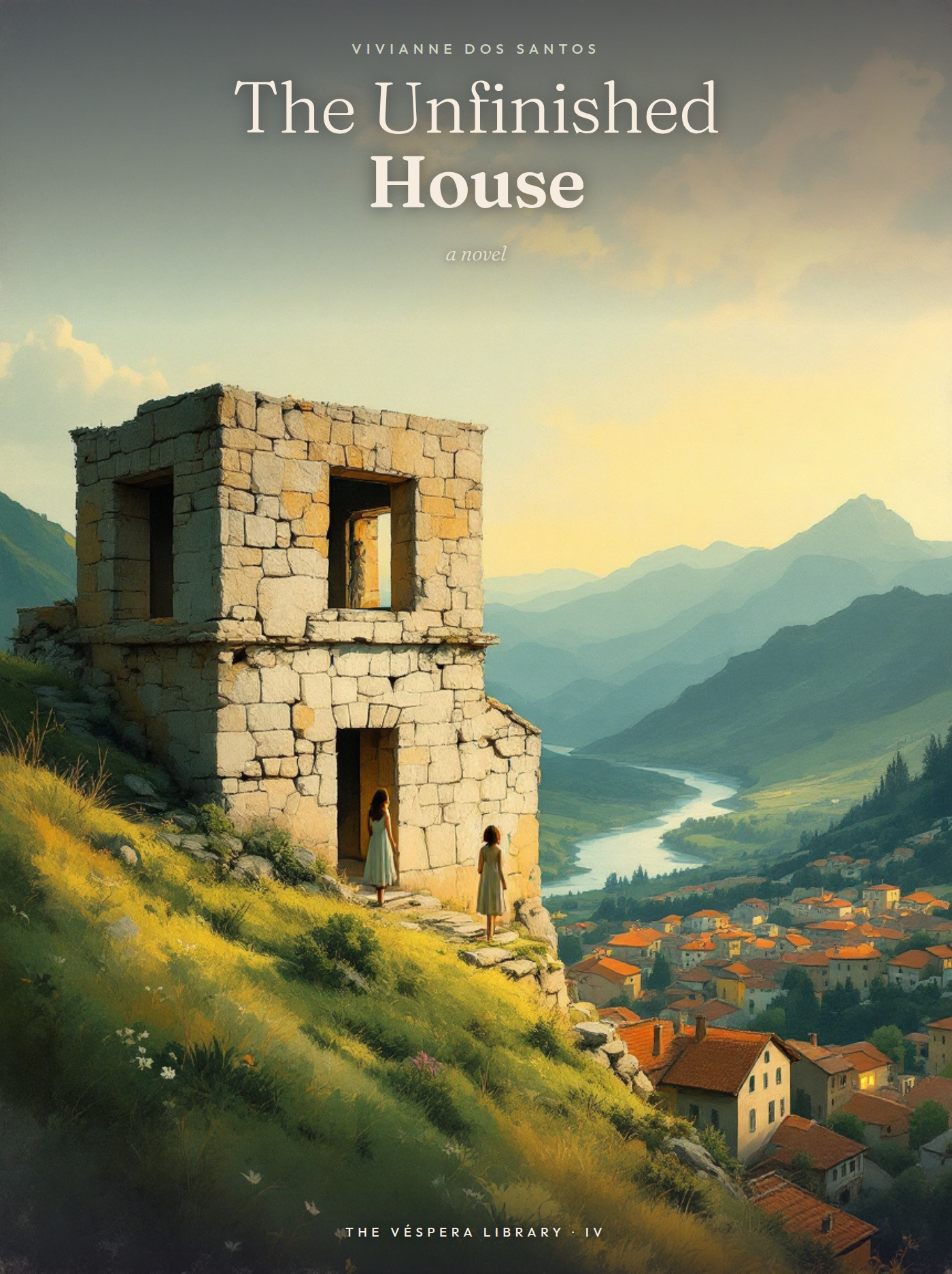
For twenty years Venturoso has been finishing the new house: when it is ready, they will marry in earnest, live in earnest, be happy in earnest. Esperança loves that man to come, his design; of the one who exists, putting-off and charming, she asks nothing. This is the year she looks at the house in the sun, beautiful as a skeleton, and asks how much of her life is walled up there.
A novel · 12 chapters, complete. Read the first one below; the whole book is in the shop.
From the register of Véspera
In the register of the village, by the hand of the Keepers who passed through the book, is found:
Esperança — hope — daughter of people of the village, born in the spring, and the name was a promise, like almost all those of Véspera, but this one was of a particular kind: the mother, who had lived a whole life awaiting the life her husband was going to give her next year, set on her daughter the name of Hope not to bless her, though she thought she did, but because hope was the one thing the house had always had in abundance, and what a house has in abundance is what it passes to its daughters, even when it is what most harms them.
The register says who married whom, and when, and keeps, without meaning to, the dates of a beginning without the date of an end. It does not say how much of a life is walled up in an unfinished house, awaiting a roof that is going to come next year. For that, books such as this one are needed.
chapter one
When the house is ready
Esperança had a phrase that organised her life the way the bell organised the village's days, and the phrase was this: when the house is ready.
When the house is ready, they would marry in earnest. When the house is ready, she would go to live with Venturoso — fortunate — the betrothed of the house on the slope. When the house is ready, the life that had been waiting twenty years to begin would begin, the true life, the in-earnest one, the one that had not yet been able to be because the house was not ready. And the house had not been ready for twenty years, and for twenty years the phrase when the house is ready had postponed everything, and Esperança said it without bitterness, with a faith the village admired aloud and lamented under its breath, because the village, which saw from outside, knew a thing that Esperança, who saw from within, did not wish to know: that a house not finished in twenty years is not a house that is taking its time; it is a house that is not going to be finished.
Venturoso had begun the house when they became engaged, and it had been a beginning full of promise, of the most beautiful the village had seen: he had bought the highest plot on the slope, with the best view of the village and the river, and raised the walls quickly, with the enthusiasm of one who builds not a house but a life, and promised Esperança that there they would make the most beautiful house in Véspera, with a veranda facing the sunrise for the two of them to take their coffee watching the sun come up, with a room for the children that would come, with a hearth where they would grow old together. And Esperança, young, in love, had believed, and had helped to dream the house stone by stone, and it had been some of the happiest weeks of her life, those in which the house rose and her life with it.
And then the house stopped. Not all at once, for that would have opened her eyes; it stopped slowly, with reasons, always with reasons, which was what made the unfinishing so easy to bear. The money for the roof was wanting, and they waited; the money came and the time was wanting, for Venturoso had his work and the house was only built on Sundays; the time came and Venturoso thought the window would after all be better on the other side, and what was done was undone to be done better, and the better took another year; and so, from reason to reason, from next year to next year, the house that was to be the most beautiful in Véspera stayed as it was, walls raised and roof half done, without doors, without windows in half the openings, with the wind coming in and the grass growing on the beaten-earth floor, a house that from afar seemed a house and from near was a skeleton, beautiful, with the best view of the village, and empty.
There was a sign, in the house, that Esperança had learned not to read, and it was the clearest of all. At the entrance to what was to be the kitchen, leaned against the wall that gave onto the sunrise, there stood, for nineteen years, a new iron gate, bought for the main entrance, still with the smith's tag tied to a bar, still with the factory paint and two spots of rust where the rain beat hardest. Venturoso had bought it in one of his bursts, one of those bursts that came upon him and that seemed the beginning of everything, and had brought it up the serra in his brother-in-law's cart, and set it there, leaned against the wall, awaiting the hinges and the posts he would raise the following Sunday. The following Sunday was nineteen years ago. Esperança remembered the day he bought it, remembered his saying to her, with that light in his eyes, "Look, Esperança, it's the gate of our house; this is where our children will come in," and she had thought it lovely, and had kissed him in front of the smith, who was called Aprígio and was a man of few words. And it was Aprígio, years later, on a Saint John's night, the drink loosened in him and his tongue more at ease, who said to her the thing she put away at the time and that only now she unfolded. "Esperança," he said to her, "I made that gate with pleasure, for it was for a house that was going to be beautiful. And to this day it pains me to go up there and see it leaned against the wall, with my tag growing mould. A gate is to be hung, woman. A gate leaned against a wall is not a gate; it is a coffin stood on end." Esperança had laughed, at the time, and told him he was drunk, and gone away offended on his account, without knowing why; and the gate went on leaning, with Aprígio's tag rotting, and it became, like the house, like the engagement, a thing that had always been there and that one stopped seeing.
And Venturoso, he, did not change at all in twenty years, and that was the hardest part to see. He went on charming, went on speaking of the house with the same enthusiasm as the first day, went on saying this year I'll finish it, Esperança, this year is the one, and saying it with such truth in his voice that Esperança believed, every year, because he believed, he did not lie, he really wanted to finish the house, he saw it ready in his head with such sharpness that he described it to Esperança as if they already lived there, the veranda, the coffee at sunrise, the hearth, and Esperança heard him describe the house that did not exist and loved him, loved him for that, for his seeing the house to come so well, for his promising so beautifully, and never noticed, because she did not wish to notice, that she was loving a man for a house he was never going to build, for a life he was never going to give, for a Venturoso who existed only in the to-come and whom the real Venturoso, the everyday one, postponed without end.
Because that was, at bottom, what Esperança loved: not the Venturoso who existed, but the one he promised to be. She loved his drawing, the design, the man he was going to be when the house was ready, when he decided, when at last he began life in earnest; and to that man to come Esperança was faithful for twenty years, awaited him, kept herself for him, put in him all the hope she had in her name; and to the real man, the one in front of her, the charming put-off who never finished anything, to him Esperança asked nothing, charged nothing, saw almost nothing, because to see him would be to lose the other, the to-come, and Esperança preferred to love the promise to having to look at the person.
They lived each in their own house, she with an old aunt she cared for, he with his mother, Sina, and they met like sweethearts of twenty years before, on Sundays, coming out of Mass, at the feasts, and it was an engagement the village no longer remarked on for being so old, an engagement that had become scenery, like the unfinished house on the slope, a thing that had always been there and that one stopped seeing. And Esperança, at forty-three, was still Venturoso's betrothed, the one who was going to marry when the house was ready, and she had her trousseau kept in a chest for twenty years, embroidered sheets that yellowed from being kept, awaiting a house to receive them, as she herself, she would perceive later, was a trousseau kept in a chest, yellowing, awaiting a life to receive her.
The aunt was called Florinda, and was the sister of Esperança's father, and it was she who had taken the girl in when her mother died and the father, widowed, sank for good into his permanent eve of things, with no head for raising a girl of sixteen. Florinda had never married. She had had, when young, a love, and the love had departed for Brazil, promising to send for her when he was settled, and she had awaited the letter of passage for ten years, with her travelling clothes ready in a case on top of the wardrobe, and the letter never came, and what came instead was the news that he had married another over there. Florinda never took the clothes out of the case. Esperança had grown up with that case on top of her aunt's wardrobe, and had asked her, as a small girl, what it was for, and the aunt had answered, without turning round, "It's for a journey I no longer make, child, but I keep it to remind me not to be a fool twice." And Esperança, at the time, had not understood; and she would take twenty years to understand that she slept, every night, beneath the roof of a woman who had awaited a man who did not come, with her luggage ready, and that she herself, in the room next door, awaited another, with her trousseau ready, and that Florinda's house was, without either of the two saying it, a house of two women waiting, each with her case packed for a life that did not come.
And there was, on the floor of what was to be the parlour, a thing that measured the twenty years better than any calendar, and that Esperança saw every time and never read: a fig tree. It had sprung up alone, from a seed a bird let fall, on the beaten-earth floor of the parlour, by what was to be the hearth, and had grown year after year inside the unfinished house, with no one planting it or pulling it up, and it was now a fig tree the height of a man, with a trunk already thick, giving figs in summer inside the house that had never been a house. And Esperança, as a girl, in the first year, had seen the little fig tree, two hand-spans high, and said to Venturoso, laughing, "Look, Venturoso, a fig tree has sprung up in our parlour, we'll have to pull it out before you lay the floor"; and Venturoso had laughed and said "I'll pull it out when I lay the floor, woman, next year"; and the fig tree stayed, because the floor did not come, and grew, and Esperança watched it grow every year, and every year it was the same joke, we'll have to pull out the fig tree before the floor, and the joke grew old with them, and the fig tree grew, and one day, without either of them noticing, the fig tree became bigger than the joke, became a tree in earnest, with shade, giving figs, inside a parlour that was still unmade; and that should have told Esperança everything, that a tree had had time to spring up and grow and bear fruit on the parlour floor before the parlour had a floorboard, but Esperança never read it, because even the fig tree in the parlour she had put away as a charm of the engagement, our fig tree, and not as what it was, a living clock marking, ring by ring, the years of a life that did not begin.
That Sunday, Esperança went up to the house, as she went up now and then, alone, to look at it, and it was a habit of hers no one understood, to go and look at the unfinished house, to stay there a while, to imagine it ready. She climbed the slope, and reached the top, and the house was as always, the walls in the sun, the roof half done, the openings bare, the grass grown inside, and Esperança went in by what was to be the door, and walked through the rooms that existed only on the floor, here the kitchen, there the bedroom, and stopped in the opening that was to be the veranda facing the sunrise, and stayed looking at the view, the village down below, the river, the best view of Véspera, and imagined, as always, the morning coffee with Venturoso watching the sun come up, and it was, as always, beautiful.
But that Sunday there was a different thing, and it was small. On the way out, passing the door opening, Esperança noticed a thing she had never noticed: on the jamb, on the door-stone that Venturoso had set twenty years before, a date was carved, the date they had begun the house, which he had carved with pride on the first day, this is the beginning of our life, he had said. And Esperança looked at the date, and did, for the first time, the sum. Twenty years. Twenty years since that date carved with pride on the stone. And she looked from the date to the house, from the stone of the beginning to the roofless skeleton, and had, for an instant, a thing she had never let herself have: she had the physical sense of time. Twenty years. The date said the beginning, and around the date there was no house, there were some walls in the wind, and Esperança, at forty-three, widow of a life that had never begun, stood a moment at the door of the unfinished house, with her hand on the stone of the date, and felt, without yet knowing how to say it, that perhaps it was not the house that was unfinished; perhaps it was she.
She came down the slope with that troubling her, and tried to push it away, as she always pushed away everything that threatened hope, with the when the house is ready, with the this year is the one, but the sum of the twenty years, once made, did not unmake itself, it stayed, as the sums one avoids a whole life stay and that one day one makes without meaning to, and Esperança reached home and went to the chest, and opened it, and took out the trousseau sheets, the ones she had embroidered when young for the new house, and saw them yellow, with the creases marked from twenty years folded, with a kept smell, and understood, with a tightening, that the sheets she had embroidered to begin a life were growing old inside the chest without ever having gone onto a bed, and that she, Esperança, was doing the same, growing old inside an engagement, without ever having gone onto life, awaiting a house that perhaps would never be finished, faithful to a promise that perhaps would never be kept, loving a man to come while the woman she was, the real one, the one of forty-three, was being left, she too, like the sheets, like the house, unused.
She folded the sheets again and put them back in the chest, because she did not yet know how to do otherwise, but she put them away in another way, with a new question in her hands, the question the house in the sun and the date on the stone had opened in her and that she could no longer close: and if the house is never finished? And if I am waiting, for twenty years, for a life that does not come? And if the Venturoso I love, the one who is going to finish the house and begin to live, does not exist, and never existed, and the only Venturoso there is is this one, the one who postpones, and I spent twenty years loving a man who does not exist, awaiting a house that is not finished, with the trousseau yellowing in a chest like my life? And she did not know how to answer, that night, and went to bed with the question, and it was the first night, in twenty years, on which the when the house is ready did not bring her sleep, because for the first time Esperança heard, beneath the phrase, the other one, the one the phrase had covered for twenty years: and if the house is never ready, Esperança? Then what of your life?
· end of the sample ·