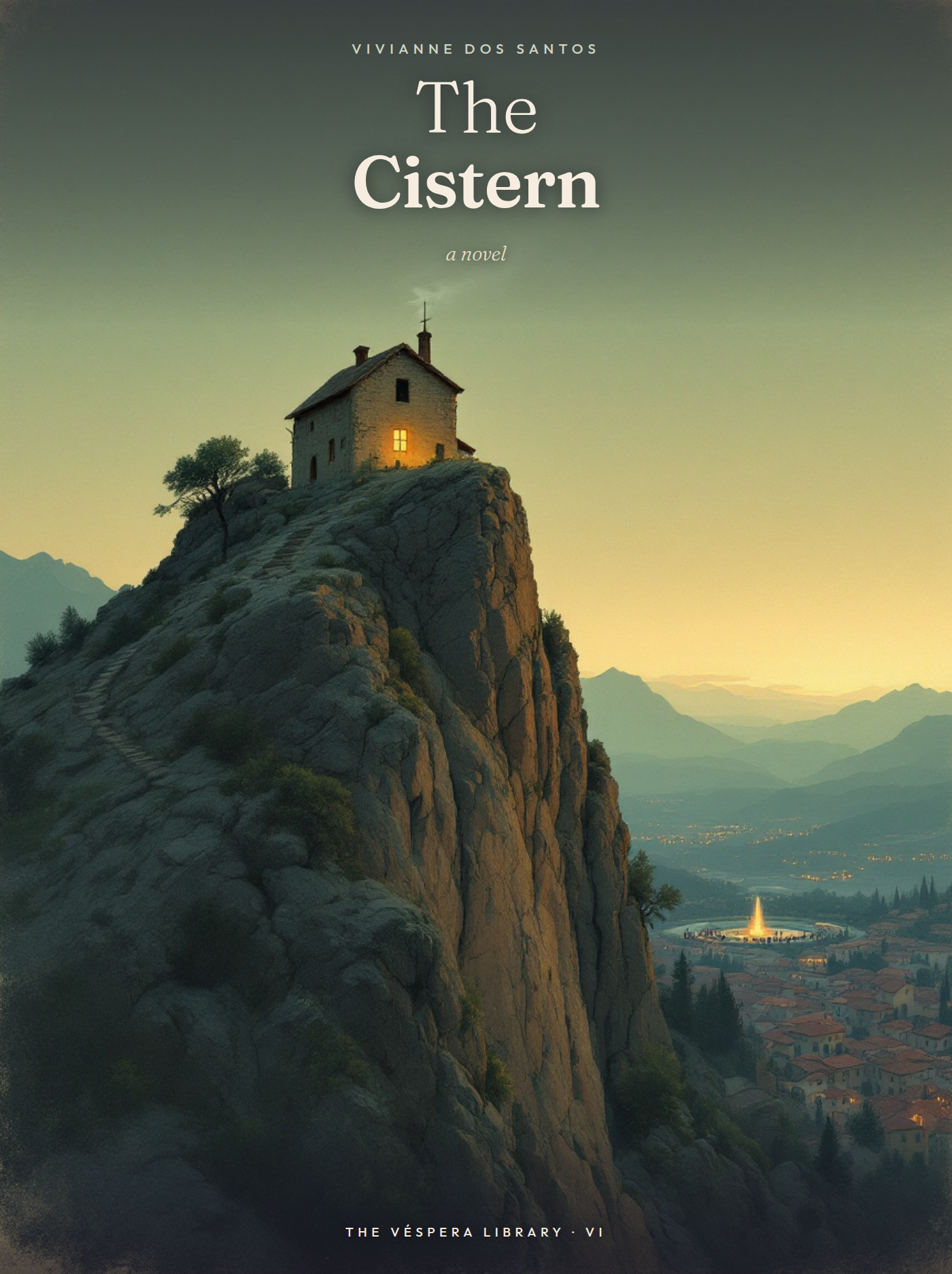
The Véspera Library · novel nineteen
The Cistern
Soledade lives in the house on the heights, the one with its own cistern that never needed the square’s fountain, and has always done everything alone: to her emigrated son she always answers all is well, to the neighbour who notices her smoke she always refuses help. As a child, on one night, she went to ask for help at a door and the door did not open, and she decided never to ask again. This is the year she learns, at sixty, the hardest thing for one who shut herself into a cistern: to come down from the house on the heights, to knock at a door before despair, and to bear the hardest thing of all, that the door should open.
A novel · 12 chapters, complete. Read the first one below; the whole book is in the shop.
From the register of Véspera
In the register of the village, by the hand of the Keepers who passed through the book, is found:
Soledade — solitude — of the Highlanders, of the house up on the heights, the one with its own cistern, and the name was a sentence before it was a name.
They called her Soledade, solitude, and she fulfilled the name to the letter, making of solitude not a misfortune that fell on her, but a fortress she raised, a house high on the mountain, with water of her own, that never needed to come down to the square, to ask of the fountain, to depend on anyone, and that had in this, her whole life, her pride and her sentence.
The register keeps the houses, and what each one has, and who comes down to the square to ask. It does not say what night it was, in childhood, that taught a girl that to ask was not safe, nor the price of the dryness of one who never lets in the water from outside, nor what it costs a cistern to knock, at last, at a door. For that, books such as this one are needed.
chapter one
The cistern of her own
In sixty years, Soledade had never once gone down to the fountain in the square, because she had her own water at home, and in that lay the greatest pride of her life: the house up on the heights of the Highlanders, with its cistern, that gathered the rainwater and the spring water and never needed to ask a single drop of anyone. And it was not only the water. There was, in the house on the heights, a whole way of living that was one long not-asking, and that came from so far back that no one in the village remembered ever having seen it begin; and whoever spoke Soledade's name said, straight after, without thinking, the one up on the heights, the one who suffices to herself, the one who does not come down. That was how the village kept her in its mouth, and that was how she kept herself within, in a phrase of three words that was her house and her prison at once: I do not need.
It was a winter morning, and Soledade, at sixty, was splitting firewood in the yard. She set the block, raised the axe above her head, let it fall, and the log split in two, and she set another, and another, with a rhythm she had kept for forty years, alone, in the cold, her breath smoking from her mouth. Her back ached, and the axe weighed on her more than it once had, and there was a pain in her shoulder that would not pass; but Soledade split the wood all the same, because firewood does not split itself, and there was no one else in the house on the heights to split it, and to ask a neighbour to split it for her was a thing that had never crossed her mind, or that had crossed it and that she had shooed away as one shoos away a fly.
She did everything like that, alone, and always had. She cut the wood, tended the garden, mended the roof when a tile fell, carried the sacks, kept the house, and never, in anything, asked a hand of anyone. When help was offered, she refused it. Once, years before, a younger neighbour, Felisberto, of the house by the mill, seeing her carry a sack of potatoes up the slope, stopped his cart on the road and offered.
"Here, Soledade, let me take it for you on the cart, since I'm going up anyway."
"Thank you, Felisberto. There's no need. I'll carry it."
"But woman, that must be a good thirty kilos, and the climb is what it is."
"I'll carry it, I'll carry it. You go about your business."
And she carried it, the sack on her back, up the slope, slowly, with Felisberto behind in the cart, at her pace, not understanding why a woman of that age would refuse a lift that fell to her from heaven; and he went off shaking his head, and reached the mill and told his wife, Custódia of the Aurora line, who still remembers it, told her that Soledade of the heights was of a stubbornness that grieved a man, that she would sooner burst with the sack on her back than put it on the cart that was going up empty. And Felisberto's wife only said, that's not stubbornness, man, that's something else, that's a woman who has something twisted up inside her about asking. I'll do it. It was the phrase of her life. I'll do it, I'll carry it, I'll see to it, there's no need, I'll manage. She said it to anything that was help, with a courtesy that was firm but whole, and she did it, however much it cost her, however old she was, however little her body would give, because asking, for Soledade, was the one thing she did not know how to do, or that she knew she did not do, for an old reason that lay at the bottom of her like the water at the bottom of the cistern, gathered and shut away for fifty years.
The stubbornness came to her from far back, and it showed itself in small things, the kind no one notices but that go on making the person. There was a ladder in the storeroom, long and old, with a rung halfway up that wobbled, and Soledade climbed it to clear the gutter of the chimney, in autumn, when the leaves blocked the spout; and each time she climbed onto that wobbling rung, alone on the roof, with the whole serra round about and no one below to hold the ladder, it crossed her mind, in a flash, that if she fell from there no one would know, and that she must take care, and she gripped tighter, and went on, and never, not for a shadow of a thought, did it occur to her to call someone to hold the ladder. To hold the ladder for one who climbs is the oldest and simplest thing one neighbour does for another in Véspera; it is asked from one window to the next, ho there, the house, come and hold this for me a moment, and the other comes, and stands below with a hand on the ladder, and they talk while the work goes on up above, and it is in those small securings that the web that holds a whole village together is made, without anyone noticing. Soledade had never asked anyone to hold her ladder. She climbed alone a ladder that wobbled, and in that, too, she had her silent pride: that of needing neither a hand below, nor a pair of eyes to see her climb.
And the village respected her for it, and admired her. That one is made of iron, they said. That one needs no one. That one, at sixty, does what many young ones do not. That one suffices to herself. And Soledade, when such things reached her ears, liked to hear them, because sufficing to herself was her pride, was what she was, the one who does not need, the cistern that has its own water and does not come down to the fountain. Each time she refused a help, said I'll do it, carried alone what another would have asked to be carried for her, she felt a deep satisfaction, that of owing nothing to anyone, of sufficing to herself, of being independent like the house on the heights, with its own water, with no need of the square.
But there was, beneath that pride, a thing that Soledade did not say, and that was the reverse of it. The house on the heights, with its cistern, did not need the fountain, it is true; but it was also far from the fountain. Far from the square, far from the gathering of the village around the water, far from the talk that is made where people cross paths filling the pitcher, far from life. And Soledade, in the house on the heights, sufficing to herself, was also alone, set apart, outside. The independence that was her pride was also her isolation, because whoever does not need the fountain does not go to the fountain, and whoever does not go to the fountain meets no one; and the cistern of her own, that spared her the going down, spared her also the meeting. Down below, in the square, the women of the village filled their pitchers and talked, and laughed, and helped one another set the pitcher on the head, and knew of one another; and Soledade, up above, with her own water, knew of no one, and no one knew of her, and she called that being free.
Her husband had died young, more than thirty years before, in an accident at the quarry. His name was Alfredo, and he was a big, quiet man, of those who work the stone, and he had died as the men of the stone die, beneath it, in the collapse of a face that gave way one rainy morning. Soledade was then in her twenties, and Domingos was a child on all fours, and she was in the kitchen making the broth when they knocked at the door in the middle of the morning, at the wrong hour, and she knew, before opening it, by the wrong hour of the knock, that it was misfortune, because knocks have their hours, and the one that morning had the hour of no good news. It was the quarry foreman, cap in hand, and behind him two men, and the foreman said only, Soledade, and said no more, because there was no need, and she stood at the door with the broth ladle still in her hand, and what came into her head, the first thing, was not the grief, for that came after and stayed; the first thing was a cold reckoning, the question of one who is left alone, and now, and the boy, and the house, and who, and the reckoning gave at once, in that instant at the door, the answer that was to govern thirty years: me. Now it is me. I'll see to it. I'll do it.
They brought him to her at the end of the afternoon, and the village came, as the village comes, the women filling the kitchen with food that no one ate and the men standing in the yard with their hats in their hands; and there came those who had to come, the gossips, the neighbour women, people offering themselves, Soledade, what do you need, count on us, don't be left alone with this. And Soledade thanked them all, dry-eyed, and said the same thing to all, thank you, I'll manage, go easy, and she went on burying her husband and dispatching the condolences with a firmness that the village took for strength and that was already the cistern closing for good over her widowhood. There was one woman, old Benvinda, the mother of the one who stands today at the counter of the grocer's, who stayed to the last, and who at the door, on leaving, took her by both hands and said, look, my girl, I know what it is, for I too was widowed young, and I'll tell you one thing: don't do this alone. No one bears a whole serra on her shoulders, and you will want to bear it, for I see it in your face. Let the village help you. That is what it is for. And Soledade listened, and thanked her, and did not let her. She thought Benvinda said it out of an old woman's kindness, and that she herself was young and had arms, and that the village that helped today charged tomorrow, that all help is paid for, and that she owed nothing to anyone and did not want to begin owing in the hour when she was weakest. And she shut the door behind the last visitor, and was left alone in the kitchen with the boy asleep and her husband in the earth, and it was that night, more than the night of the Fonsecas' door, that the cistern finished turning itself to stone; because a woman who is widowed young, with a child to raise and a house to hold on the serra, either asks and depends, or sets her teeth and does everything alone; and Soledade, who since she was a girl had sworn not to ask, set her teeth, and raised her son alone, and kept the house alone, and the village, seeing her, instead of helping her, admired her, that widow is made of iron, she raises her son alone and never complains.
And Domingos grew up watching his mother do everything alone, hearing her say I'll do it, never seeing her ask anything of anyone; and he learned, without anyone teaching him, that his mother needed nothing, that his mother sufficed to herself, and he carried that lesson into life, and it was for that reason, in part, that he could emigrate without remorse, because a mother who needs nothing is a mother one can leave alone on the serra without carrying the weight of leaving her.
The only tie was the son. Domingos, emigrated, far away, on the other side of a border, who telephoned on Sundays. And even him Soledade did not let in.
"So, Mother, how are you?" Domingos would ask. "Is everything all right there?"
"Everything's all right, son," Soledade would answer. "Don't you worry. Everything's fine."
"Do you need anything? Shall I send something?"
"I don't need anything. Get on with your life, that I manage here."
And Domingos, far off, set at ease by the everything's all right, did not press, because his mother had always been that way, made of iron, of not needing, and he had grown up hearing her say I'll do it, and had grown used to a mother who did not ask. And so he did not see, from afar, that the everything's all right was the greatest lie of the house on the heights, the lie Soledade told to everyone, to her son, to the village, the lie of sufficing to oneself, that hid a woman who needed, like everyone, and who had decided, fifty years before, one night, never again to let it be known.
There was a spot on the path, halfway down, at a bend in the track, from which one could see the square below and the fountain in the middle of it. Soledade passed by there when she went down to the village to see to what she had to see to, the papers, the market, the Mass that she went to seldom, and from the bend of the path she would see, without stopping, for stopping to look was a thing she did not do, she would see the women around the fountain. It was in the morning, almost always, that being the hour of the water, and there were half a dozen of them, with their pitchers, and the water running from the stone spout into the trough, and them waiting their turn, and talking. They talked loudly, for the water covered the voices and it was necessary to speak over it, and they laughed, and Soledade, from up on the path, heard the laughter rise, ragged on the wind, without knowing at what. She saw Mariana of the Reis line helping old Encarnação set the pitcher on her head, with that knack that is an art, the roll of cloth coiled on the crown and the pitcher balanced on top without a hand to hold it, and the old woman setting off already upright with the water on her head and her whole body in one line, and Mariana calling after her something that made her laugh. She saw Aurora, sometimes, who went to the fountain too, though she had a well, because one went to the fountain also for the going, for the being there, for the knowing of the others. And Soledade would stand a moment at the bend of the path, with her empty pitcher that she had no need to fill because she had her cistern at home, looking at all that below as one who looks at a feast from a closed window: from outside, from above, without the sound, without mixing in. And what she felt, if she stopped to feel it, which she did not, was a strange thing, half pride and half something else without a name, the pride of not having to go down there to queue for water, and beneath it, hidden, a lack, that of no one ever having set the pitcher on her head, that of never having laughed over the noise of the water, that of always passing at the bend of the path with an empty pitcher and going on up, to her own water, to her own house, to her solitude with the name of a house that suffices to itself. And she went on. She always went on up, and told herself within that she was free, and the fountain was left at her back, full of people, running.
And there came a night, at the start of winter, on which the cistern gave the first sign that it might run dry.
Soledade was alone in the house on the heights, after supper, mending a shirt by the lamplight, with the fire already low in the hearth and the silence of the serra coming in through the cracks, when she felt her chest tighten. It came slowly, at first, a clenching, like a fist closed inside her chest; and then a pain that rose up her left arm, from shoulder to elbow, and a shortness of breath, as if the room had all at once lost its air, and a cold sweat breaking out on her forehead and her lip, and her heart beating out of time, leaping and stopping and leaping. She laid the shirt in her lap, and the needle fell from her hand and hung from the thread, and she sat still in the chair, very upright, with her hand on her chest, waiting, with the coldness of one who has seen people die and knows what this may be. The pain clenched harder, and Soledade thought, without alarm, with a strange clarity, it is the heart, I may be dying here, in this chair, this night.
And she looked at the telephone, on top of the dresser, three steps from her, the black telephone on its cord with which she spoke to her son on Sundays, and for an instant her right hand, the one that did not hurt, lifted from the chair and meant to go to it, to call someone, Aurora halfway down the slope, the health centre, the bus, whoever it might be, to say come, I'm ill, help me. And the hand stayed in the air, halfway to the telephone, trembling. And it did not go. It came down again, settled again in her lap, beside the shirt, because to call was to ask, and she did not ask, not even dying. She thought, in the chair, with the pain clenching, that if she called Aurora she would have to say I'm ill, come, and that Aurora would come, by night, up the slope, and find her there with the shirt in her lap, at her mercy, in need, and that this, to be found at her mercy, was worse, at the bottom of her, than death itself; and she stayed in the chair, alone, with the pain, waiting for it to pass or to carry her off, and she called no one, because in the house on the heights, at that hour, with the door shut and the cistern full and no one to ask, Soledade preferred to risk dying alone to doing the thing she had sworn, fifty years before, never to do again.
The pain passed, after some minutes that seemed to her an hour. Soledade sat breathing, slowly, feeling her heart slacken, and when she had recovered herself, and the house returned to silence, a fright stayed with her, and the fright left her a question, the first of many: and what if one day it does not pass? And what if one day I fall, here, alone, and the pain does not pass, and there is no one, because I never let anyone in? Who notices me, in the house on the heights, with the door shut? How long do I lie here, fallen, before anyone marks that there is no smoke from my chimney?
And Soledade, with the question, did not change at once, for a cistern of fifty years is not changed in a night. But the question stayed, dripping, at the bottom of her, and it was the first drop of a new water: the suspicion that the sufficing to herself, which had been her pride all her life, might be, in the end, her sentence. The sentence of dying alone in the house on the heights, of dryness, for never having learned the one thing the cistern lacked, the one thing that could save it from running dry: to let in the water from outside, which is, in people, to ask.
· end of the sample ·